The Steel Importer's Triple Stack: CBAM, the 50% Quota Duty and Melt-and-Pour Evidence
The Steel Importer's Triple Stack: CBAM, the 50% Quota Duty and Melt-and-Pour Evidence
If you import steel into the EU, the "carbon border tax on steel" is only one of three regimes now applying to the same shipments. They are legally separate, they bill you at different moments, and they all lean on the same mill-level data. Treating them as one compliance project is the cheapest way to manage them.
The three regimes
CBAM. The definitive phase has applied since 1 January 2026. Importers pay for embedded emissions through certificates priced at the quarterly EU ETS average, adjusted for free allocation (the CBAM factor is 97.5% in 2026). Certificate sales open on 1 February 2027 and the first declaration is due on 30 September 2027 [1].
The Steel Regulation. Regulation (EU) 2026/1384 has applied since 1 July 2026. It sets tariff-rate quotas of 18,345,922 tonnes a year across 30 product categories, with a 50% duty on out-of-quota volumes [1]. Tariff-free volumes are roughly halved compared with the old safeguard, and the out-of-quota duty rises from 25% to 50% of customs value, applied on top of other duties such as anti-dumping [2].
Melt-and-pour evidence. Since 1 October 2026, Implementing Regulation (EU) 2026/1963 requires importers to state the country of melt and pour in the customs declaration and back it with verifiable evidence [1].
How they differ in practice
The key difference is timing and what drives the cost. Quota duties are paid at customs clearance, while CBAM costs are not paid at the border [2]. The 50% duty depends on when you import, because it only applies after a quota is exhausted. CBAM depends on how the steel was made, because cost scales with embedded emissions and the ETS price. Melt-and-pour carries no duty, but without evidence customs can reject the declaration before any tariff question arises [1].
One estimate on a 2024 trade basis, with no trade adjustments, puts imports hit by both measures at EUR 26.6 billion, with added costs of about 37%. Of that, about EUR 5.9 billion comes from out-of-quota tariffs and about EUR 3.8 billion from CBAM at 2024 carbon prices and full phase-in [2]. Treat this as an order-of-magnitude illustration, not a forecast.
Several figures in this article come from industry commentary sites rather than the Official Journal. Check Regulations 2026/1384 and 2026/1963 and the Commission's CBAM guidance before relying on any number in a contract or budget.
What melt-and-pour actually requires
The country of melt and pour is where raw steel or iron was first produced in liquid form and cast into its first solid state. It can differ from customs origin: a coil rolled in one country from slab melted in another declares the melting country [1].
- Primary evidence: a Mill Test Certificate showing the country of melt and pour and the heat number.
- Transition: until 30 September 2027, alternative documents such as invoices, supplier declarations or production records can support the declaration. From 1 October 2027 the certificate becomes the mandatory base document [1].
- Mills without the line: mills whose certificates lack a melt-and-pour country line have twelve months to change the format [1].
- EEA: EEA countries are exempt from the quotas and the 50% duty but still need traceability [1].
Melt-and-pour is not yet a basis for allocating quotas. From 1 October 2027 the Commission takes the data into account for the country distribution of quotas, and by 30 June 2028 it must assess whether it should become the full basis [1]. That makes today's data quality a future market-access issue as well as a paperwork one.
Where chains break
Exposure is highest where there is intermediate processing. A service centre buying substrate from a re-roller may hold a certificate from the last mill, not the furnace. The heat number has to carry through every step [1].
Check which products fall under the Steel Regulation annex and which under the CBAM annex. They overlap but are not identical.
Check every Mill Test Certificate for country of melt and pour and heat number, and ask suppliers to amend formats well before October 2027.
Add the melt-and-pour request to your CBAM supplier data collection so suppliers answer once.
Refresh your Q4 budget with the Q3 2026 certificate price of EUR 82.32 per tonne CO2e, and model quota exhaustion separately.
The bottom line
The three regimes will not be merged by the Commission, which insists on their separation [1]. But your suppliers' furnace, route and heat-level records feed all three. Collect them once, verify them once, and keep them traceable through every processing step.
Does CBAM replace the steel quota duty?
No. They are legally independent regimes that apply to overlapping products. You can owe both.
Is the 50% duty a CBAM cost?
No. It is a customs duty on out-of-quota volumes under the Steel Regulation, paid at clearance.
Can I still use invoices as melt-and-pour evidence?
Until 30 September 2027, alternative documents can support the declaration if they identify the country and heat number. After that the Mill Test Certificate is the mandatory base.
Do EEA imports need melt-and-pour evidence?
Yes. EEA countries are exempt from the quotas and the 50% duty but remain subject to the traceability requirement.
Sources: Melt and pour rules in force: the steel importer triple stack [1]; EU steel safeguards and CBAM: how importers are affected [2].
Related reading
What the US Asked the EU to Change in the CSDDD Guidelines, and What It Means for Non-EU Companies
In August 2026 the US government sent the Commission detailed comments on the CSDDD guidelines. Here is what it asked for, which asks are likely to be contested, and what non-EU companies should plan for before the guidelines land in Q1 2027.
EU Carbon Import Thresholds: Who Is Truly Exempt Under the CBAM 50-Tonne Rule - and How Importers Cross It by Accident
The CBAM 50-tonne de minimis exempts ~90% of importers - but the aggregation rules, broker obligations, and group-entity traps catch many by surprise. Here's exactly how it works.
CBAM Penalties Explained: The Two Tiers, the EUR 100 Base Rate, and What Non-Compliance Really Costs
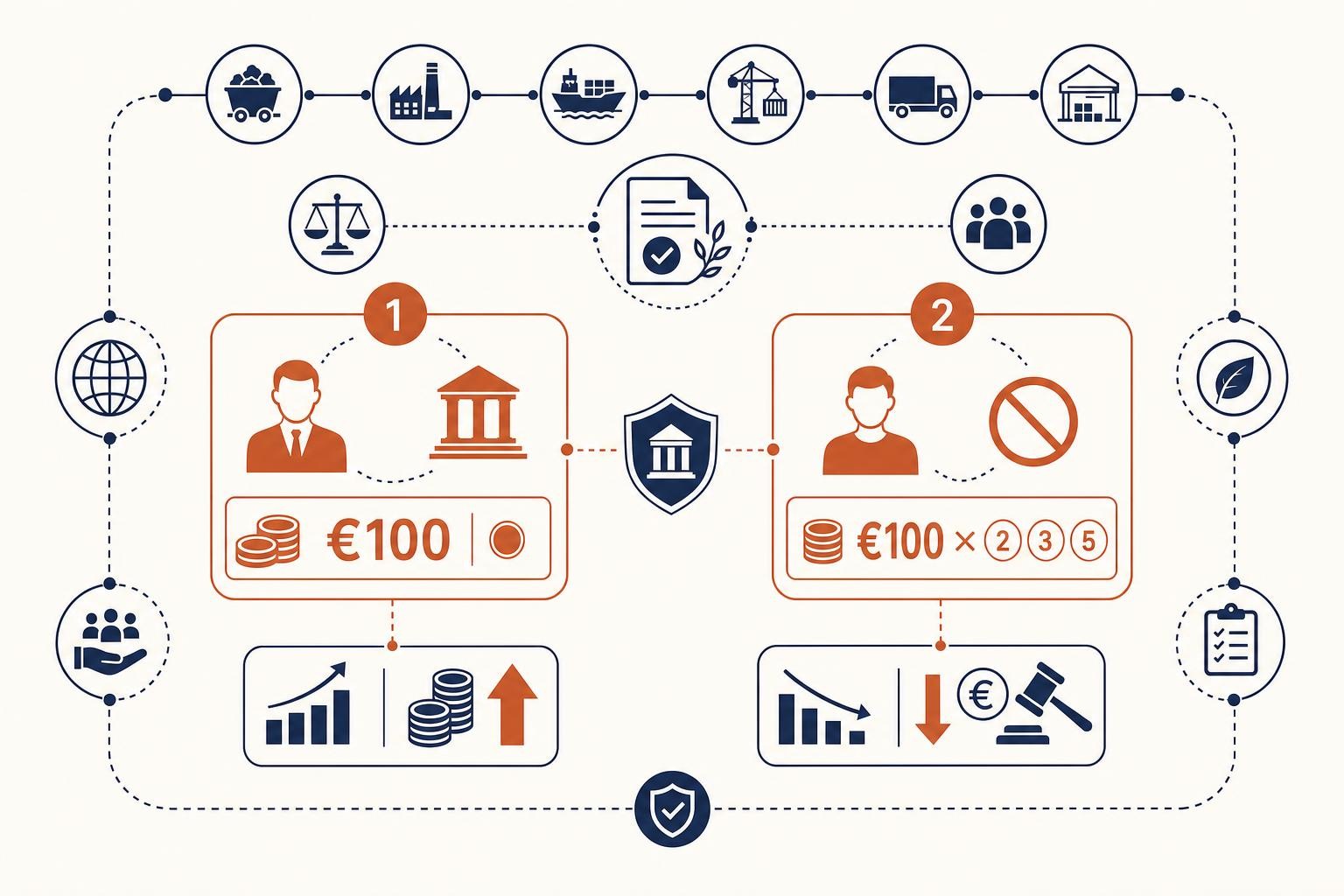
CBAM penalties come in two tiers: EUR 100 per uncovered certificate for authorised declarants and three to five times that for unauthorised importers. Here is how each is calculated and how to avoid them.