CBAM Penalties Explained: The Two Tiers, the EUR 100 Base Rate, and What Non-Compliance Really Costs
CBAM Penalties Explained: The Two Tiers, the EUR 100 Base Rate, and What Non-Compliance Really Costs
CBAM is now financially binding, so the penalty regime matters. Importers often ask a simple question: what happens if we get it wrong? The answer depends on whether you are an authorised declarant or an unauthorised importer. The figures below come from a secondary summary of Regulation (EU) 2023/956 as amended, so verify article numbers against the consolidated text before relying on them.
Tier 1: authorised declarants
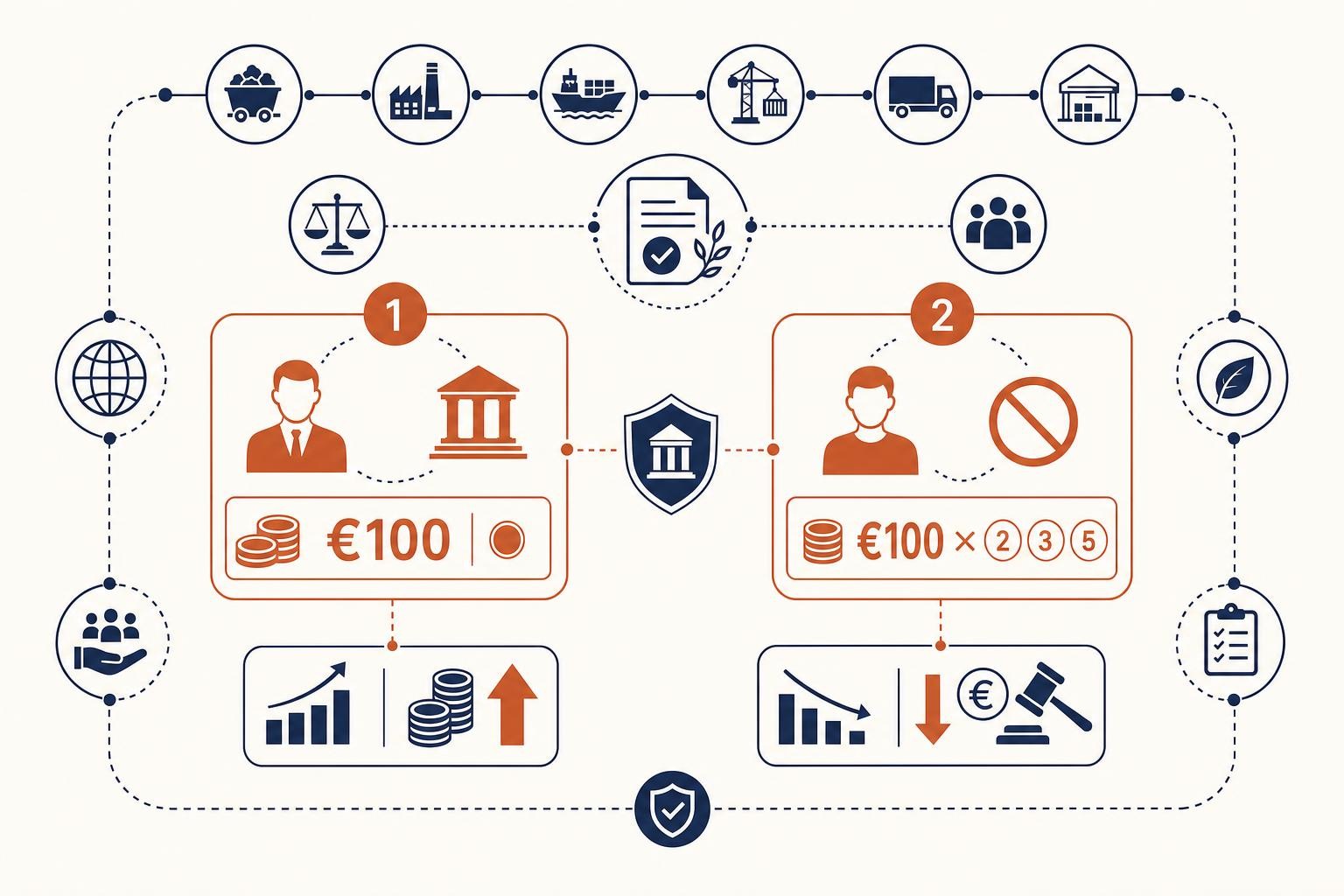
An authorised declarant that fails to surrender enough certificates by 30 September faces a penalty of EUR 100 per tonne of CO2e for each certificate not surrendered, before indexation, under Article 26(1) per CBAM Guide. The rate is indexed to inflation.
Crucially, the penalty does not replace the certificates. Paying it does not release you from surrendering the outstanding certificates. The same source gives a worked example: 1,000 uncovered certificates mean at least EUR 100,000 in penalty plus EUR 82,320 for the certificates themselves, EUR 182,320 in total. The EUR 82.32 figure matches the Q3 2026 certificate price.
Tier 2: unauthorised importers
Anyone other than an authorised declarant who brings CBAM goods into the EU without complying faces three to five times the Tier 1 amount, or EUR 300 to 500 per certificate before indexation (CBAM Guide). The national competent authority sets the multiplier based on duration, gravity, scope, intent, repetition and cooperation.
Two details matter for small importers:
- Where the 50-tonne threshold is exceeded, all embedded emissions for the calendar year count, not just the excess.
- The penalty may be reduced if the threshold was exceeded by no more than 10%, but not below the Tier 1 level.
| Tier 1: authorised declarant | Tier 2: unauthorised importer | |
|---|---|---|
| Trigger | Certificates not surrendered by 30 September | Importing CBAM goods without authorisation or compliance |
| Penalty | EUR 100 per certificate (indexed) | 3 to 5 times Tier 1, EUR 300-500 (indexed) |
| Certificates still owed? | Yes | No, paying the penalty releases declaration and surrender duties for those imports |
| Reduction possible? | If a third party supplied incorrect information | If threshold exceeded by 10% or less, not below Tier 1 |
What applies to 2026 imports
The definitive phase began on 1 January 2026, so both tiers are enforceable. Penalties for 2026 imports are assessed after the first declaration deadline of 30 September 2027 (CBAM Guide). Importers that applied for authorisation by 31 March 2026 may import provisionally until the authority decides. If authorisation is refused, the authority sets embedded emissions from 1 January 2026 using default values, and these feed the Tier 2 penalty. Our guide on pending authorisations covers the contingency plan.
The older regime for non-reporting between October 2023 and December 2025 carried penalties of EUR 10 to 50 per tonne of unreported emissions, with enforcement varying by member state.
Default values carry a rising markup, so an authority-set estimate will almost always cost more than your own verified data. Good records are the cheapest penalty defence.
How to stay out of both tiers
Check whether you are an authorised declarant or have a pending application, and who the declarant is when a customs representative is involved.
Monitor cumulative net mass per year so you do not cross it unnoticed.
Sales open in February 2027, so plan the purchase before the 30 September 2027 surrender.
Hold supplier and verifier evidence to counter default-value assessments.
FAQ
Can I pay the penalty instead of buying certificates?
As an authorised declarant, no. The penalty is on top of the obligation to surrender. Unauthorised importers are released from surrender for those imports once the penalty is paid.
Who sets the Tier 2 multiplier?
The national competent authority, within the 3 to 5 range.
Are these figures indexed?
Yes, the base rate is indexed to inflation, so the amounts at the time of assessment may be higher.
Related reading
What the US Asked the EU to Change in the CSDDD Guidelines, and What It Means for Non-EU Companies
In August 2026 the US government sent the Commission detailed comments on the CSDDD guidelines. Here is what it asked for, which asks are likely to be contested, and what non-EU companies should plan for before the guidelines land in Q1 2027.
The Steel Importer's Triple Stack: CBAM, the 50% Quota Duty and Melt-and-Pour Evidence
Steel importers now face three overlapping EU regimes: CBAM certificates, a 50% duty on out-of-quota volumes, and mandatory melt-and-pour evidence. Here is how they interact and what to fix before October 2027.
EU Carbon Import Thresholds: Who Is Truly Exempt Under the CBAM 50-Tonne Rule - and How Importers Cross It by Accident
The CBAM 50-tonne de minimis exempts ~90% of importers - but the aggregation rules, broker obligations, and group-entity traps catch many by surprise. Here's exactly how it works.