EUDR Goes Live on 30 December 2026: Reusing Your Deforestation Data for CSDDD Risk Assessment
EUDR Goes Live on 30 December 2026: Reusing Your Deforestation Data for CSDDD Risk Assessment
Two EU due diligence regimes are arriving on very different clocks. The EU Deforestation Regulation (EUDR) applies from 30 December 2026. The Corporate Sustainability Due Diligence Directive (CSDDD) applies from 26 July 2029. Companies in scope of both have a rare opportunity: build the data foundation once for EUDR, then reuse it when CSDDD risk assessment begins.
The two timelines
Per Arendt's summary of the Commission's 4 May 2026 simplification review, the EUDR applies from 30 December 2026 for large and medium-sized companies and for timber-sector micro and small enterprises, and from 30 June 2027 for all other micro and small enterprises.
For CSDDD, Covington reports a transposition deadline of 26 July 2028 and a single application date of 26 July 2029. It covers EU companies with more than 5,000 employees and EUR 1.5 billion net worldwide turnover, and non-EU companies with EUR 1.5 billion of EU turnover. Member states must set a maximum penalty of 3% of net worldwide turnover.
That is a gap of roughly two and a half years in which EUDR data will already exist inside your organisation.
What EUDR requires
EUDR covers seven commodities: cattle, cocoa, coffee, palm oil, rubber, soya and wood, plus derived products. Arendt reports that the Commission's draft delegated act would add soluble coffee and some palm oil derivatives, and remove cattle skins and hides and retreaded tyres. Operators submit a due diligence statement through the EU Information System before products enter or leave the market. Penalties can reach 4% of annual EU-wide turnover, with confiscation and temporary exclusion from public procurement.
For downstream operators and traders, the guidance reduces the burden: the "collect and keep" obligation can be met by retaining information already received, such as invoices, without routinely verifying reference numbers.
How EUDR data feeds CSDDD
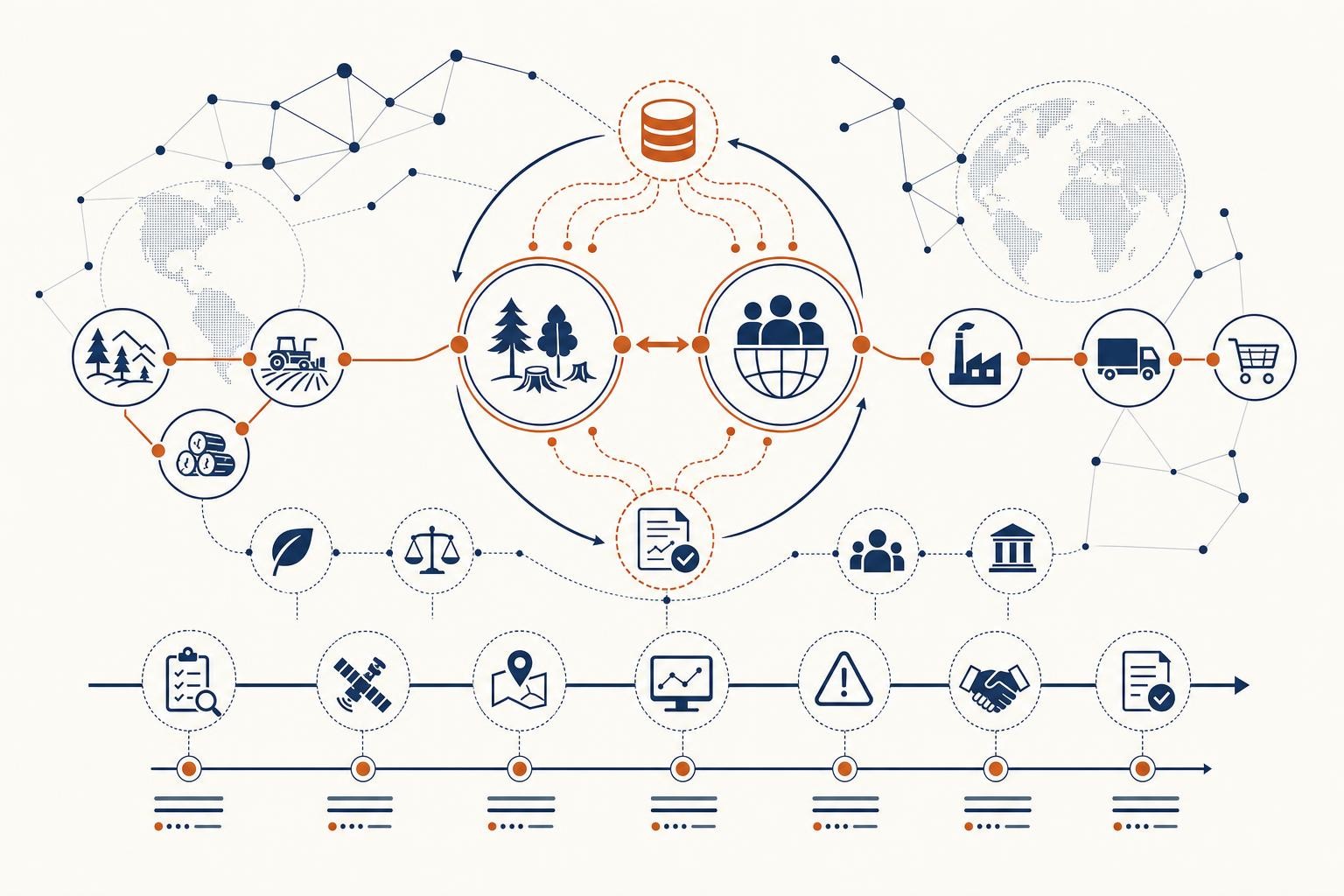
CSDDD asks companies to scope where adverse impacts are most likely and most severe, then assess those areas in depth. Per Covington, step one is a scoping exercise using reasonably available information, and step two is an in-depth assessment of the prioritised areas. Arendt notes that EUDR geolocation and traceability data feeds into CSDDD chain-of-activities risk assessments.
Store supplier identity, country of origin, plot geolocation and legality evidence in a single structured dataset rather than in an EUDR-only silo.
Add fields for sector, geography and known human rights or environmental risk factors so the same record supports scoping later.
Where EUDR work surfaces legality or land-use concerns, flag those suppliers for in-depth CSDDD assessment.
Retain invoices, statements and reference numbers. They support both EUDR audits and CSDDD accountability.
CSDDD limits requests to partners with fewer than 5,000 employees to cases where information cannot reasonably be obtained otherwise. Reuse EUDR data before sending new questionnaires.
Where the two regimes differ
EUDR is a directly applicable regulation focused on specific commodities, with product-level geolocation and a statement per placement on the market. CSDDD is a directive that must be transposed into national law, and it sets a risk-based duty across human rights and environmental impacts in the chain of activities.
One industry overview from Tracex describes EUDR as the more specific rule that would prevail over CSDDD where they overlap. Treat that as one commentator's reading rather than settled guidance, and seek legal advice on how the two interact for your sector.
EUDR data is not a CSDDD compliance file. CSDDD covers many risks EUDR does not, and CSDDD national laws are not yet in force. Use EUDR data as an input to scoping, not a substitute for it.
When does the EUDR apply?
From 30 December 2026 for large and medium-sized companies and timber-sector micro and small enterprises, and from 30 June 2027 for other micro and small enterprises.
When does CSDDD apply?
Member states must transpose it by 26 July 2028, and it applies from 26 July 2029.
Can downstream operators rely on invoices for EUDR?
According to the Commission guidance summarised by Arendt, the collect-and-keep obligation can be met by retaining information already received, such as invoices.
Is EUDR data enough for CSDDD?
No. It is a useful input for risk scoping, but CSDDD covers wider human rights and environmental impacts.
What are the maximum penalties?
EUDR fines can reach 4% of annual EU-wide turnover. CSDDD member states must set a maximum of 3% of net worldwide turnover.
Sources reviewed: Arendt via LexGO, Covington, Tracex. General information, not legal advice.
Related reading
What the US Asked the EU to Change in the CSDDD Guidelines, and What It Means for Non-EU Companies
In August 2026 the US government sent the Commission detailed comments on the CSDDD guidelines. Here is what it asked for, which asks are likely to be contested, and what non-EU companies should plan for before the guidelines land in Q1 2027.
The Steel Importer's Triple Stack: CBAM, the 50% Quota Duty and Melt-and-Pour Evidence
Steel importers now face three overlapping EU regimes: CBAM certificates, a 50% duty on out-of-quota volumes, and mandatory melt-and-pour evidence. Here is how they interact and what to fix before October 2027.

EU Carbon Import Thresholds: Who Is Truly Exempt Under the CBAM 50-Tonne Rule - and How Importers Cross It by Accident
The CBAM 50-tonne de minimis exempts ~90% of importers - but the aggregation rules, broker obligations, and group-entity traps catch many by surprise. Here's exactly how it works.