What goes in a CSDDD due diligence questionnaire
What goes in a CSDDD due diligence questionnaire
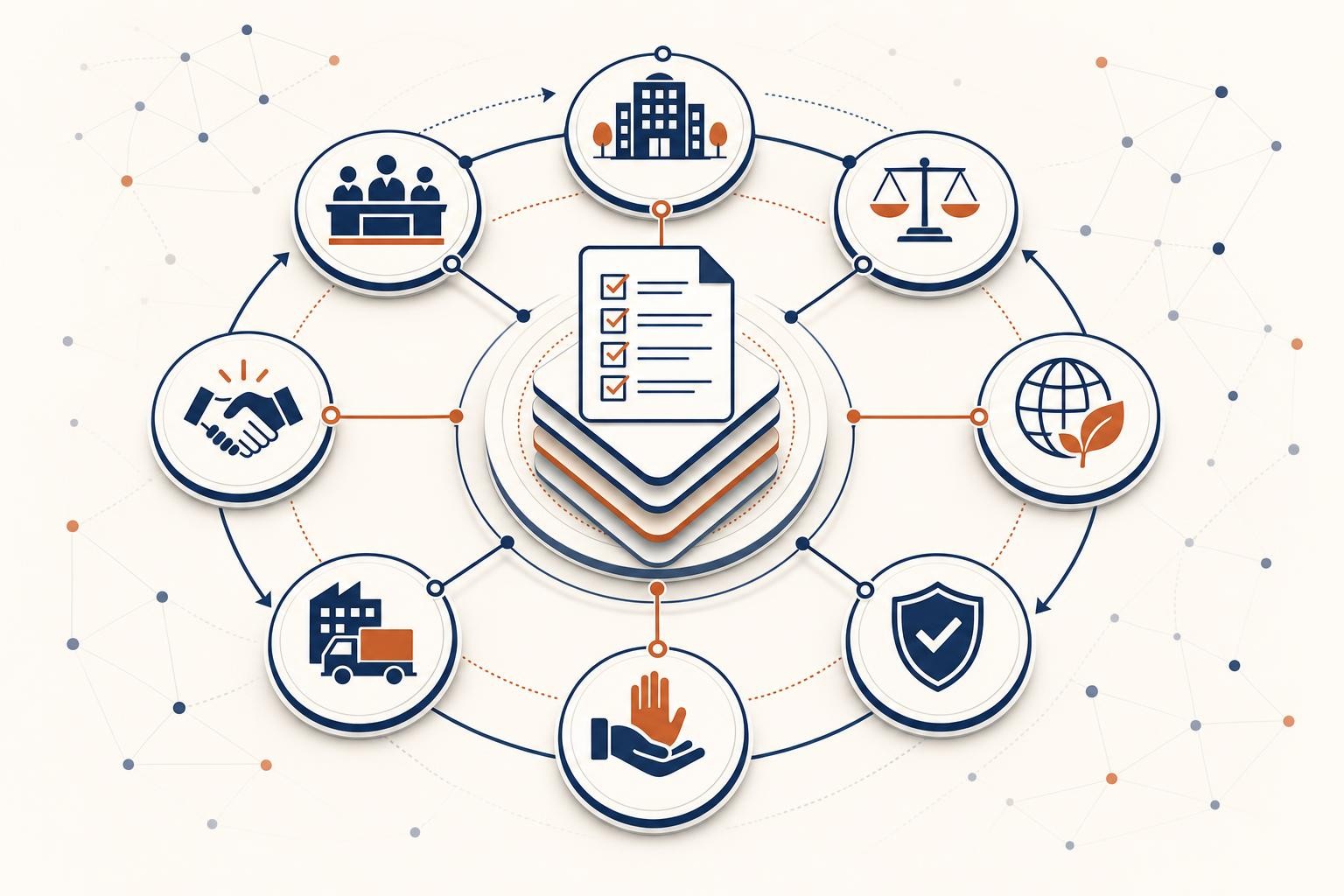
A due diligence questionnaire (DDQ), or supplier self-assessment questionnaire (SAQ), is how a company gathers human-rights, environmental, ethics and governance information from its suppliers. Under the EU Corporate Sustainability Due Diligence Directive (CSDDD), it's the practical engine of step two - identifying and assessing impacts. Here's what a good one contains, whichever side of the request you're on.
The eight sections to expect
A well-built CSDDD questionnaire works through, roughly, eight areas:
- Company & ownership - who the entity is, where it operates, headcount, ultimate parent.
- Governance & policies - a human rights / due-diligence policy, a code of conduct, and a named person responsible.
- Human rights & labour - forced and child labour, freedom of association, working hours, fair and living wages, no recruitment fees.
- Health & safety - a safety management system, protective equipment, accident reporting.
- Environment & climate - permits, pollution and waste control, energy and emissions.
- Business ethics & anti-corruption - anti-bribery controls, sanctions compliance, data protection, a whistle-blowing channel.
- Supply-chain transparency - how far the supplier can see into its own sub-tier suppliers.
- Grievance & remediation - a complaints mechanism and a way to put things right.
Our free CSDDD due diligence questionnaire template lays all eight out as ready-to-send questions, with a simple Yes / Partial / No / N-A response scale and space for evidence.
Keep it proportionate: the value-chain cap
The most common mistake under the new rules is over-asking. Omnibus I added a value-chain cap: an in-scope company generally may not demand information beyond a standardised set from a business partner with fewer than 5,000 employees, unless it genuinely can't be obtained otherwise.
So a good questionnaire is risk-based, not exhaustive. Focus on your direct (tier-1) partners first, ask what's relevant to the actual risk, and only go deeper when you have plausible information of a real impact.
If you're the buyer
- Send it to your highest-risk direct suppliers first; prioritise by country and sector risk.
- Use the answers to score and prioritise, not to "pass or fail" a supplier.
- Turn gaps into a corrective-action plan with owners and dates - not an instant exit. The directive favours engaging and, where needed, suspending a relationship over simply cutting it.
- Back the questionnaire with a supplier code of conduct and the right to verify.
If you're the supplier
- Answer honestly - a "Partial" with an improvement note beats an empty "Yes".
- Attach evidence: policies, certificates, contract clauses, audit reports.
- You can push back on excessive asks under the value-chain cap.
- Keep your completed copy. The next customer request then takes hours, not weeks. A short human rights policy signals maturity fast.
The bottom line
A CSDDD questionnaire isn't box-ticking - it's how large companies turn the directive's due diligence duty into something their suppliers can actually act on. Done well, it's proportionate, evidence-based, and the same template serves both buyer and supplier.
Download the free CSDDD due diligence questionnaire, or subscribe to The CSDDD Brief for updates as the guidance evolves.
Sources: Directive (EU) 2024/1760 as amended by Directive (EU) 2026/470; OECD Due Diligence Guidance for Responsible Business Conduct. Guidance, not legal advice.
Related reading
The UK-EU ETS Linkage Negotiation: What It Means for CBAM Exemption - and When
UK goods entering the EU face CBAM charges today - with no carve-out. The only route to exemption runs through ETS linkage. Here's the state of that negotiation, what it would actually change, and how to plan under uncertainty.
CBAM's Missing Half: What the Temporary Decarbonisation Fund Means for EU Exporters
CBAM equalises carbon costs on imports but leaves EU exporters exposed as free allocation disappears. This post explains the export carbon leakage gap, the proposed Temporary Decarbonisation Fund, and what exporters should do now.
CBAM and Customs Special Procedures: Why Inward Processing Defers Your Obligation, Not Cancels It
Inward processing doesn't exempt you from CBAM - it defers it. Here's exactly when the obligation triggers, what data you need to hold, and who must be the authorised declarant.