Beyond the EU: The Carbon Border Tax Domino Effect Is Already Here
If your compliance team spent the last two years focused on the EU Carbon Border Adjustment Mechanism, that focus was well placed. But if the EU is still the only regime on your radar, you are already behind.
The EU CBAM entered its definitive, charging phase on 1 January 2026 - the world's first fully operational carbon border tax. The UK's equivalent follows on 1 January 2027. Australia has completed a formal carbon leakage review. Canada is in active discussion. The World Economic Forum's December 2025 white paper on border carbon adjustments describes companies across the globe "rapidly preparing for the EU CBAM and a potential new era of BCA proliferation."
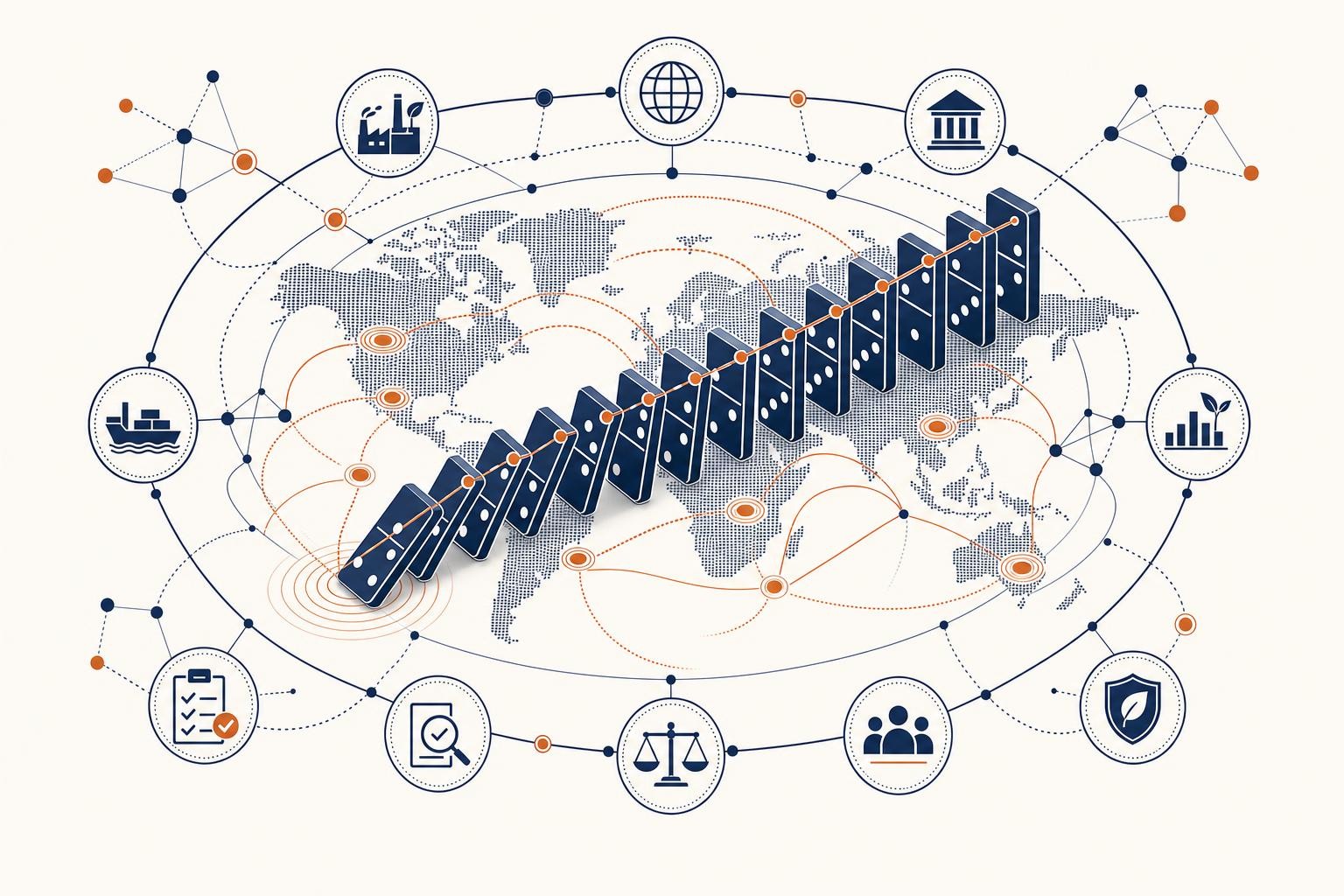
This is not a future scenario. The domino effect is already in motion.
The EU CBAM: The First Domino Falls
After a two-year transitional period focused on reporting, the EU CBAM flipped to real financial obligations on 1 January 2026. The definitive phase introduces concrete financial obligations for importers of carbon-intensive goods - cement, iron and steel, aluminium, fertilisers, electricity, and hydrogen - ensuring they face carbon costs equivalent to those borne by European producers.
The mechanics are now live: EU importers, or their indirect customs representatives, importing more than the single mass-based threshold of 50 tonnes of CBAM goods into the EU must hold an authorised CBAM declarant status. By 30 September 2027, importers must submit their first CBAM declaration and surrender the corresponding CBAM certificates.
The CBAM factor - the share of embedded emissions that must be covered - ramps gradually. In 2026, only 2.5% of embedded emissions are priced; by 2034, the factor reaches 100%. The cost is real now, and it compounds every year.
The UK CBAM: The Second Domino, and It's Different
The UK is the most consequential second mover. The UK Carbon Border Adjustment Mechanism, taking effect January 1, 2027, will tax carbon-intensive imports to prevent carbon leakage and ensure importers face carbon costs comparable to those borne by domestic producers under the UK Emissions Trading Scheme.
The Finance Act 2026 made provision for UK CBAM in law, granting HMRC powers to run and enforce the mechanism, and setting the framework for further secondary legislation. The statutory instruments were laid before Parliament in July 2026, confirming the 1 January 2027 commencement date.
What the UK CBAM covers
The UK CBAM applies to five sectors: aluminium, cement, fertilisers, hydrogen, and iron and steel. Glass, ceramics, and electricity are excluded at launch, though glass and ceramics may be added later. That last point matters: unlike the EU, the UK does not include electricity in its initial scope.
UK CBAM starts charging on 1 January 2027, with no transitional reporting-only phase. The first accounting period is the whole of 2027, with the first return and payment due by 31 May 2028. That is a deliberate contrast with the EU, which ran a report-only transitional phase from October 2023 before charging from January 2026.
The threshold that catches people out
The UK's registration trigger is value-based, not mass-based. Individuals will not need to register or account for CBAM if the total value of their CBAM goods passing a tax point is below a minimum threshold of GBP 50,000 over a rolling 12-month period. HMRC estimates this threshold removes over 80% of otherwise-affected importers while still covering about 99% of embodied emissions.
Compare that to the EU's 50-tonne mass threshold - a completely different test, applied by a different authority, under a different registration regime.
How the rate is set
The CBAM rate will be adjusted quarterly, reflecting the average UK ETS price over the prior quarter. That means the UK CBAM is pegged to the UK ETS, not the EU ETS - a separate carbon market with its own price trajectory. At a UK-EU Summit in May 2025, the UK and EU committed to working toward linking their respective emissions trading schemes, with formal talks commencing in January 2026 - but until any link is agreed, the two prices remain distinct.
UK CBAM vs EU CBAM: the four differences that catch traders out
- Threshold type: UK uses a value-based GBP 50,000 test; EU uses a mass-based 50-tonne test.
- Sector scope: UK covers 5 sectors (no electricity); EU covers 6 sectors (including electricity).
- Price reference: UK CBAM rate tracks the UK ETS; EU CBAM tracks the EU ETS — two separate markets.
- Registration authority: UK importers register with HMRC; EU importers register via the CBAM Registry with their national competent authority.
The Wider Domino Effect: Who's Next?
The EU and UK are not acting in isolation. In the wake of the EU's initial CBAM pilot phase, many other jurisdictions - including Canada, the United States, Australia, the United Kingdom and Türkiye - are exploring border carbon adjustments of their own, implying a potential proliferation of similar policies over the coming years.
Australia's Carbon Leakage Review has recommended a border carbon adjustment to complement its Safeguard Mechanism, focusing initially on cement. Beyond these developments, Canada and the United States continue exploring BCA policies.
Canada pursues CBAM development through federal backstop integration with provincial carbon pricing systems, targeting implementation between 2027 and 2029.
Academic research published in late 2025 found that the CBAM has already demonstrated a powerful spillover effect by incentivising the acceleration of carbon pricing roadmaps across EU trade partners, suggesting that trade-related climate policy can drive global momentum. The OECD's 2025 analysis confirms the mechanism's logic: the CBAM can effectively prevent carbon leakage - and that finding is precisely what is driving other jurisdictions to follow suit.
What This Means If You Trade Into Both the EU and UK
For any business that exports to both markets - or imports into both - the practical reality is parallel compliance. The two regimes share a common logic but are not interoperable.
Emissions data: reusable in principle, not in practice (yet)
The good news: the UK has deliberately designed its emissions monitoring and verification methodologies to work alongside the EU's, with the aim of reducing duplicative data collection. A supplier's verified production-level emissions data can, in principle, feed both regimes.
The catch: the reporting formats, submission portals, and accounting periods differ. EU declarants submit quarterly CBAM reports and an annual declaration via the CBAM Registry; UK importers submit an annual return to HMRC for 2027, moving to quarterly from 2028. Your supplier's data may be the same; the paperwork around it is not.
Precursor emissions: the UK goes further
Complex goods that contain in-scope precursor materials are also caught, and the UK counts all embedded precursor emissions, which is broader than the EU approach. If you import fabricated steel components, for example, the UK will look further up the supply chain than the EU currently does.
Default values: a different safety net
Both regimes offer default emissions values for importers who cannot obtain supplier-specific data. But the UK's defaults are set separately from the EU's - and the default is not a soft option. Where your supply chain is genuinely cleaner than the product average, a default value can overstate your emissions and inflate the bill. Investing in actual verified data pays dividends across both regimes.
A Practical Checklist for Dual-Regime Exposure
If you import carbon-intensive goods into both the EU and UK, or if you are a non-EU/non-UK exporter supplying both markets, work through these questions now:
- EU scope check: Do your imports exceed 50 tonnes of CBAM goods per year? If yes, you need an authorised CBAM declarant status and are already in the charging phase.
- UK scope check: Do your UK imports of CBAM goods exceed GBP 50,000 over any rolling 12-month period? If yes, you will need to register with HMRC ahead of 1 January 2027.
- Sector overlap: Are you in electricity? You face EU CBAM but not UK CBAM (at launch). Are you in glass or ceramics? Neither regime catches you yet - but the UK has flagged possible future inclusion.
- Supplier data: Businesses should engage with overseas suppliers to obtain verified actual emissions data, which may significantly reduce CBAM liability compared with default values. Start those conversations now - the UK's first monitoring period begins 1 January 2027.
- Carbon price credits: Both regimes allow a deduction for carbon prices already paid in the country of origin. Businesses should evaluate whether qualifying overseas carbon prices may be deducted from their liability. The eligibility criteria differ between the two regimes.
- Watch the ETS link talks: While EU CBAM currently applies to imports from the UK, the Government has said that this will change if the EU and UK are successful in linking their respective emissions trading systems. A linked ETS could eventually mean mutual CBAM exemptions - but that outcome is years away.
The Strategic Takeaway
The EU CBAM was never going to be the last carbon border tax. It was always the first. The introduction of border carbon adjustments as a new feature of the carbon-pricing landscape highlights a fundamental tension between climate and trade. The EU CBAM is designed primarily to prevent carbon leakage and ensure the equivalent treatment of domestic and imported goods - but it also raises concerns about trade protection, competitiveness and economic growth.
Those tensions are precisely why other jurisdictions are moving: they cannot afford to let the EU set the terms of carbon-adjusted trade unilaterally. The UK has legislated. Australia is consulting. Canada is modelling. The question for exporters and importers is no longer whether more regimes are coming - it is how fast, and whether your compliance infrastructure can scale to meet them.
The businesses that build verified emissions data pipelines now, engage suppliers on monitoring methodology, and track both the EU and UK regimes in parallel will be the ones best placed when the next domino falls.
Related reading
The UK-EU ETS Linkage Negotiation: What It Means for CBAM Exemption - and When
UK goods entering the EU face CBAM charges today - with no carve-out. The only route to exemption runs through ETS linkage. Here's the state of that negotiation, what it would actually change, and how to plan under uncertainty.
CBAM's Missing Half: What the Temporary Decarbonisation Fund Means for EU Exporters
CBAM equalises carbon costs on imports but leaves EU exporters exposed as free allocation disappears. This post explains the export carbon leakage gap, the proposed Temporary Decarbonisation Fund, and what exporters should do now.
CBAM and Customs Special Procedures: Why Inward Processing Defers Your Obligation, Not Cancels It
Inward processing doesn't exempt you from CBAM - it defers it. Here's exactly when the obligation triggers, what data you need to hold, and who must be the authorised declarant.