CBAM Default Values Explained: What They Are, Why They're Expensive, and How to Escape Them
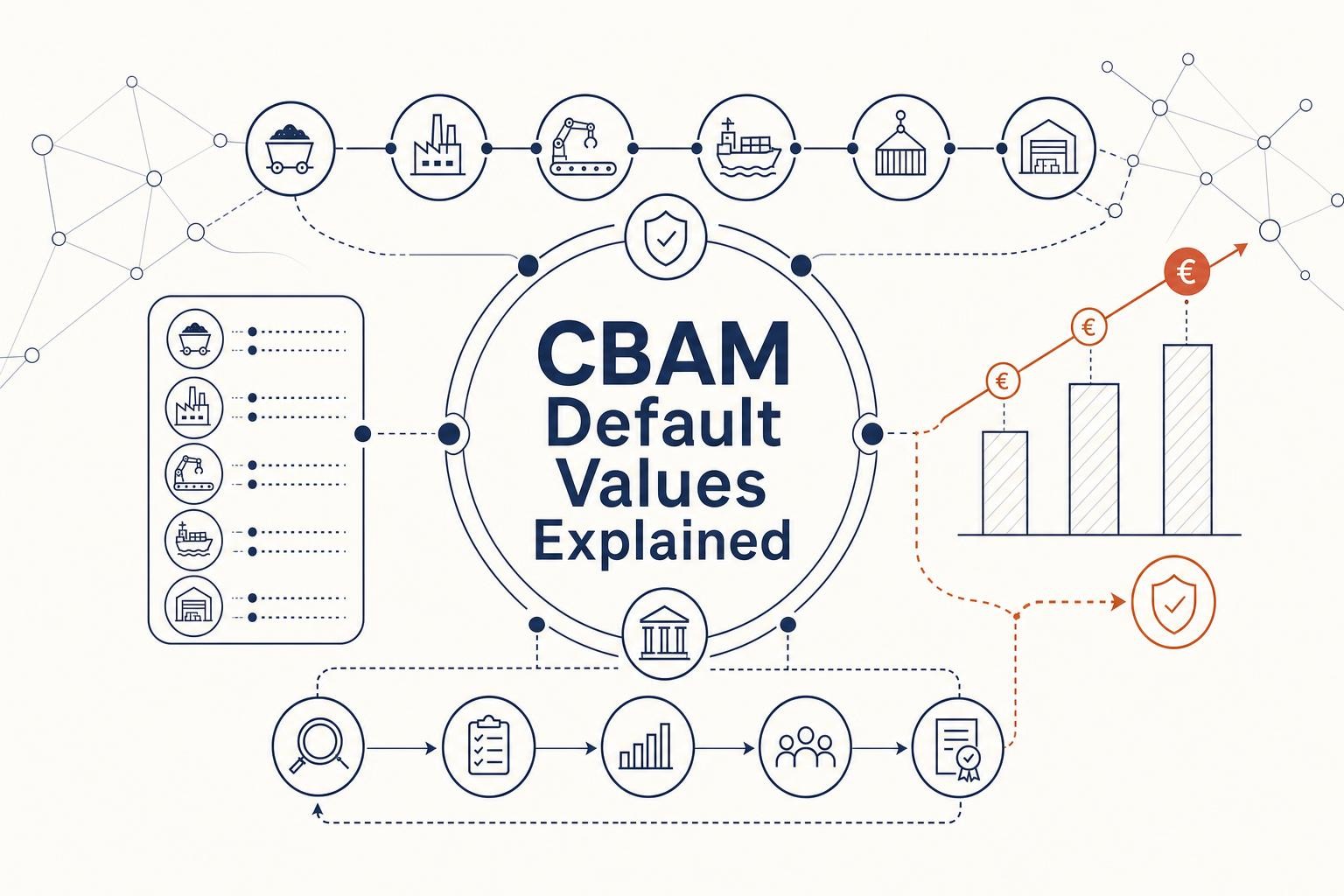
If you import steel, aluminium, cement, fertilisers, hydrogen, or electricity into the EU, you already know that CBAM - the Carbon Border Adjustment Mechanism - is no longer a reporting exercise. Since 1 January 2026, every tonne of carbon embedded in your imports creates a real certificate obligation, priced against the EU Emissions Trading System (ETS).
What fewer importers have fully absorbed is this: the emissions figure you plug into your declaration is not neutral. If you can't get actual, verified data from your supplier, you fall back on the Commission's CBAM default values - and those defaults are deliberately calibrated to cost you more. The longer you rely on them, the more expensive they get.
This post is a dedicated deep-dive on default values: what they are, why they're structured the way they are, when you have no choice but to use them, and the concrete path to replacing them.
What CBAM default values actually are
CBAM default values are standardised emissions intensities - expressed in tonnes of CO₂ equivalent per tonne of product - published by the European Commission for each CBAM product category. They are differentiated by country of origin and by production route (for example, blast-furnace steel versus electric arc furnace steel).
The legally binding default values for the definitive period are set out in Commission Implementing Regulation (EU) 2025/2621, adopted on 16 December 2025 and published in the Official Journal on 31 December 2025 - one day before the definitive period began on 1 January 2026.
The regulation covers three distinct sets of values: direct emissions for non-electricity goods, indirect emissions for non-electricity goods, and values for imported electricity. Where a country is not explicitly listed in the annexes, the importer must use the "other countries and territories" fallback row - typically the most conservative figure of all.
Designed to be conservative - by law
The Commission's own impact assessment is explicit about the design intent. The regulation states that default values, including mark-ups, "should be determined using a conservative approach that ensures that embedded emissions are not underestimated when applying default values." In plain English: the Commission does not want defaults to be a cheap shortcut. They are set at the higher end of the emissions range for each product type and country, so that any installation operating more cleanly than the country average is penalised for not proving it.
The Commission's stated rationale is that allowing importers to apply default values lower than actual embedded emissions would compromise CBAM's core objective of preventing carbon leakage.
This is not an accident or a rounding error. It is deliberate policy.
The markup: a growing penalty for non-measurement
The base default value is already conservative. On top of that, the regulation adds a mark-up - an upward adjustment that increases every year.
Under IR (EU) 2025/2621, default values for most CBAM sectors are increased by a 10% markup in 2026, rising to 20% in 2027, and reaching 30% from 2028 onwards.
The International Carbon Action Partnership (ICAP) describes this "top-up" as explicitly intended to discourage reliance on default values and incentivise importers to report actual, verified emissions data instead.
The effect compounds quickly. An importer relying on defaults for blast-furnace steel from a high-emissions origin country is not just paying for a conservative base figure - they are paying that figure inflated by 10% in 2026, 20% in 2027, and 30% from 2028 onward. The gap between what a well-measured installation actually emits and what the default charges you for widens every single year.
The fertiliser exception
Fertilisers receive significantly more favourable treatment: their default values carry only a 1% annual markup across 2026, 2027, and 2028, rather than the 10%-30% schedule applied to other sectors.
The European Commission introduced this lower markup specifically to limit the pass-through of CBAM costs to food prices. French Commissioner Stéphane Séjourné described it as "an exceptional situation to avoid price increases." Fertilizers Europe confirmed the 1% cap in a February 2026 statement, noting it was designed to ease farmers' concerns about affordability.
This does not mean fertiliser importers are off the hook - the base default values for fertilisers are still conservative, and the 1% annual increment still applies. But the urgency to replace defaults with actual data is somewhat lower for this sector than for steel, aluminium, cement, or hydrogen.
When you're effectively forced onto defaults
In an ideal world, every importer would have verified, installation-level emissions data from every supplier before their first annual declaration (due 30 September 2027 for the 2026 import year). In practice, several scenarios push importers onto defaults whether they want to be there or not.
Supplier non-response. Your supplier doesn't share emissions data, doesn't understand the request, or doesn't have the internal systems to calculate it. Without their data, you have nothing to verify - and nothing to report except the default.
Verification bottlenecks. Even if your supplier provides data, it must be verified by an accredited CBAM verifier via a physical site visit to each production installation. Verification must follow the order of the manufacturing chain. Since facilities cannot calculate their full 2026 emissions until year-end, and the declaration deadline is September 2027, verification queues are already forming. Importers who start late may find themselves unable to complete verification in time.
Ramp-up gaps. Many importers are still building the internal processes - supplier outreach, data templates, verifier contracts - to collect actual data systematically. For 2026 imports, some will simply not have everything in place.
If you rely on default values for your 2026 declaration, you are not just paying a conservative emissions figure — you are paying that figure with a 10% markup on top. For a high-volume importer of blast-furnace steel or primary aluminium, that markup can represent a material six-figure cost difference versus verified actual data. And in 2027, the markup rises to 20%.
Visualise your default vs. actual cost exposure
Use the calculator below to see how the markup affects your CBAM certificate bill - and what switching to verified actual data could save you.
The path off defaults: what you actually need to do
Escaping default values requires two things: actual emissions data from your supplier, and third-party verification of that data. Neither is optional if you want to report actual rather than default figures.
Step 1 - Get the data from your supplier. The EU provides a standardised communication template that non-EU producers use to report installation-level embedded emissions. This covers direct emissions (from the production process itself) and, where relevant, indirect emissions (from electricity consumed). Your supplier fills this out at the installation level for each facility producing your CBAM goods. Our supplier data collection guide walks through this process step by step, including how to handle unresponsive suppliers and what to do when you source from multiple installations.
Step 2 - Get the data verified. Actual emissions data only counts if it has been verified by an accredited CBAM verifier - a body accredited under EN ISO/IEC 14065, the same standard used for EU ETS verification. Verification requires a physical site visit to each production installation. Our accredited verifier guide explains how to find a verifier, what the site visit involves, and how to manage the timeline to meet the September 2027 deadline.
One important nuance: you do not need to replace defaults for 100% of your imports before you see savings. Even partial supplier coverage - replacing defaults for your highest-volume or highest-emissions origins - reduces your certificate bill. The 80/20 rule applies: focus first on the suppliers and origins that drive the most embedded emissions exposure.
Default values are a fallback, not a strategy
It is worth being direct about what the markup schedule means in practice. The Commission has structured CBAM default values so that the cost of not measuring increases every year. In 2026, the markup is 10%. In 2027, it doubles to 20%. From 2028, it reaches 30% - and stays there. The base default values are already set at the conservative end of the emissions range. The markup is then applied on top of that.
The Commission's default values are to be revised by December 2027 at the latest, meaning the base figures themselves may also change - not necessarily downward.
For most importers of steel, aluminium, cement, or hydrogen, treating defaults as a long-term compliance strategy is not a cost-neutral choice. It is a growing annual penalty for non-measurement. The sooner you start collecting actual supplier data and getting it verified, the sooner you stop paying that penalty - and the more time you have to build the supplier relationships and verification pipeline before the 2027 deadline.
The default values exist because the Commission needed a fallback for situations where actual data genuinely cannot be obtained. They were never designed to be a comfortable resting place.
Related reading
The UK-EU ETS Linkage Negotiation: What It Means for CBAM Exemption - and When
UK goods entering the EU face CBAM charges today - with no carve-out. The only route to exemption runs through ETS linkage. Here's the state of that negotiation, what it would actually change, and how to plan under uncertainty.
CBAM's Missing Half: What the Temporary Decarbonisation Fund Means for EU Exporters
CBAM equalises carbon costs on imports but leaves EU exporters exposed as free allocation disappears. This post explains the export carbon leakage gap, the proposed Temporary Decarbonisation Fund, and what exporters should do now.

CBAM and Customs Special Procedures: Why Inward Processing Defers Your Obligation, Not Cancels It
Inward processing doesn't exempt you from CBAM - it defers it. Here's exactly when the obligation triggers, what data you need to hold, and who must be the authorised declarant.