The UK-EU ETS Linkage Negotiation: What It Means for CBAM Exemption - and When
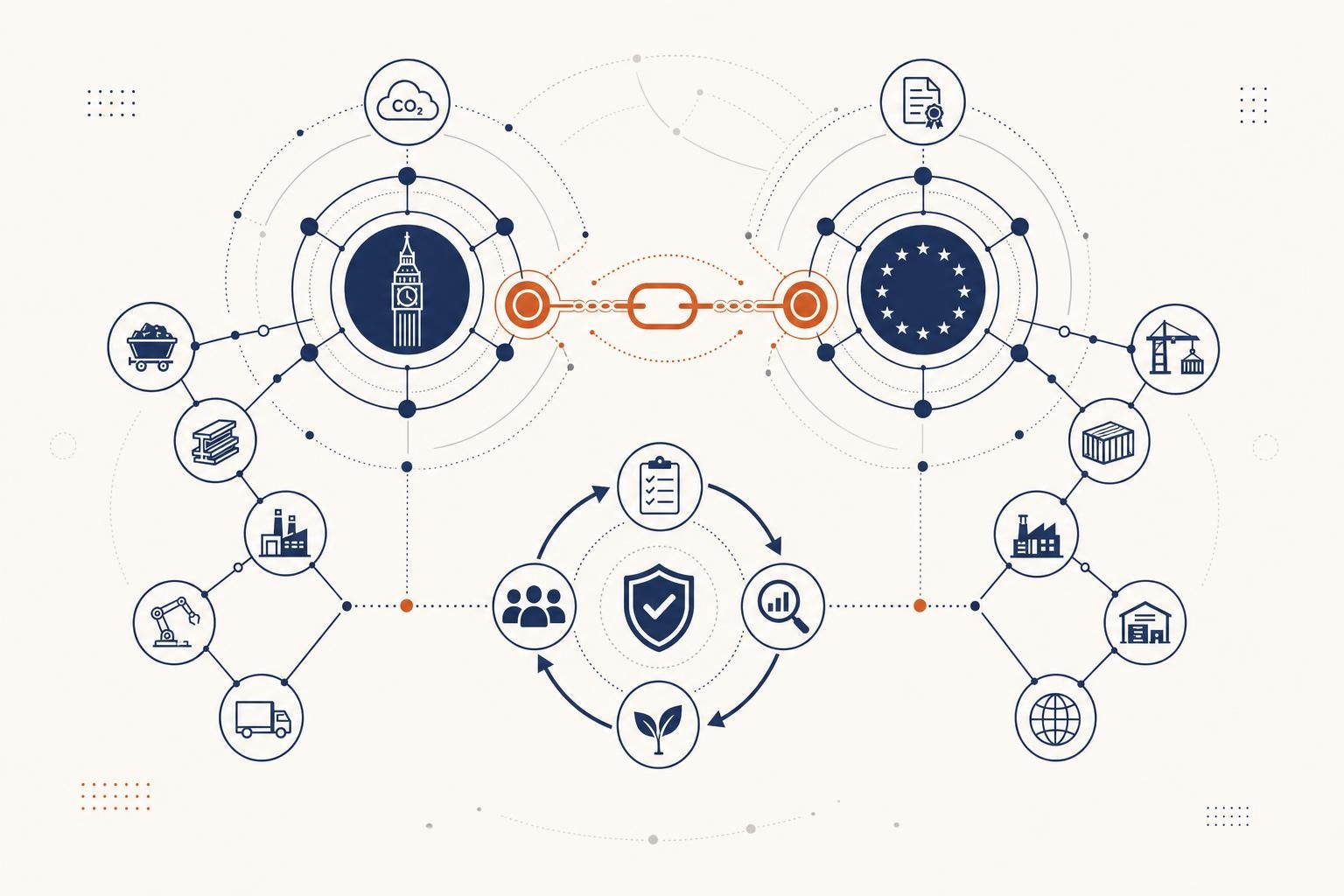
UK steel, aluminium, cement, fertiliser, and hydrogen exporters shipping into the EU have been subject to the EU's Carbon Border Adjustment Mechanism since 1 January 2026. There is no UK carve-out. There is no interim exemption. The only credible path to relief runs through a single negotiation: formally linking the UK Emissions Trading Scheme (UK ETS) with the EU Emissions Trading System (EU ETS).
That negotiation is live, politically significant, and unresolved. This post tracks it in detail - what has been agreed, what has been proposed, and what remains genuinely uncertain - and draws out the practical consequences for UK exporters, EU importers, and the trade compliance teams on both sides.
Note: ETS linkage negotiations are moving quickly. The position described here reflects publicly available information as of early September 2026. Verify the current status before acting on any of the scenarios below.
The Timeline in One Place
Understanding where we are requires knowing how we got here. The sequence matters because each step is a necessary but not sufficient condition for the next.
May 2025. At the first UK-EU Summit since Brexit, the informal agreement to link the EU ETS and UK ETS came on 19 May 2025 as part of the Common Understanding on a Renewed Agenda for Cooperation. This was a political commitment, not a treaty. Several of these commitments will require further negotiation, possibly leading to new UK-EU agreements.
November 2025. On 13 November 2025, the Council of the EU formally authorised the European Commission to begin negotiations with the UK on linking their ETS systems, which could enable qualification for mutual exemptions from each side's CBAM.
January 2026. On 14 January 2026, EU Climate Commissioner Wopke Hoekstra announced that the EU and UK would start formal negotiations on linking their respective ETSs in the week of 19 January. He confirmed that both sides are aiming to conclude the talks as soon as possible, but declined to lay out a specific timeline.
1 January 2026. The EU CBAM definitive phase began. The EU's CBAM came into force in January 2026, meaning UK imports to the EU are already subject to an additional charge. No UK exemption was granted.
Mid-2026. The EU and UK have committed to reach an agreement by the time of the 2026 UK-EU Summit, linking the UK and EU Emissions Trading Schemes to create a uniform carbon market and eliminate CBAM charges. However, with the UK-EU Summit postponed until after the summer, campaigners are urging both sides to agree to a mutual CBAM exemption and finalise the ETS agreement as quickly as possible, to avoid months of uncertainty and rising costs for UK operators in the meantime.
Current status. The UK and EU have expressed a common understanding regarding the potential linking of the UK ETS and EU ETS, recognising that such linkage could facilitate mutually agreed exemptions under their respective CBAMs. But the agreement is not yet legally binding as the technical detail of a full linkage agreement is still being negotiated.
1 January 2027. The UK is also intending to implement its own CBAM legislation, with the Government confirming that CBAM will be introduced from 1 January 2027, with enabling legislation included in the Finance Bill 2025-26.
Why "Having a Carbon Price" Is Not Enough
This is the most important conceptual point for UK exporters to grasp, and it is frequently misunderstood.
The UK does have a carbon price. UK ETS allowances (UKAs) are a real compliance cost for UK manufacturers. Surely, the argument goes, that should count for something under the EU CBAM?
It does - but only partially, and only in a specific way. Under Article 9 of the EU CBAM Regulation, an EU importer can deduct from their CBAM certificate obligation the carbon price that was already paid in the country of origin. If a UK steel producer paid £X per tonne of CO₂ under the UK ETS, that amount can in principle be offset against the EU CBAM charge - but only when actual verified emissions data is used, not default values, and only to the extent the UK carbon price is lower than the EU ETS price.
Article 9 deduction ≠ exemption. The Article 9 carbon price deduction reduces your CBAM certificate bill — it does not remove the obligation to register as an authorised CBAM declarant, report embedded emissions, or surrender certificates. And if the UK ETS price is below the EU ETS price (which it has been for much of 2026), the deduction only covers part of the liability. Full exemption from CBAM scope requires ETS linkage — not just a domestic carbon price.
The UK ETS front-year contract significantly widened its discount to the EU throughout the first quarter of 2026, as scant signs of progress on efforts to link the two systems reduced previous optimism of an impending price convergence. The UK ETS front-year contract closed on average around £14.75/t of CO₂e below its EU counterpart in Argus assessments over January-March, having widened from a low of £6.85/t CO₂e in mid-January to a high of £25/t CO₂e.
That spread is the gap between what Article 9 can offset and what UK exporters actually owe. It is a real, live cost - not a theoretical one.
The route to full exemption is different in kind. Covered goods are exempt from the CBAM if they originate in countries that apply the EU ETS or have an ETS that is fully linked to the EU ETS, and impose a carbon price on the emissions released during production of covered goods without rebates beyond those foreseen in the EU ETS. Linkage, in other words, takes UK goods out of CBAM scope entirely - not just reduces the bill.
The Switzerland Precedent: What Linkage Does and Does Not Deliver
Switzerland is the only non-EEA country whose ETS is currently linked to the EU ETS, and its experience is instructive on both counts.
Goods originating in Switzerland are exempt from the EU CBAM due to the linking of the Swiss and EU emissions trading systems. That is the prize: full out-of-scope status, not a reduced bill. Switzerland is the only non-EEA country with an emissions trading system linked with the EU ETS, an agreement that took several years to negotiate.
But the Swiss exemption comes with conditions that the UK-EU negotiation will need to replicate. The Federal Council has clearly stated that it wants to adapt Switzerland's ETS in step with the EU so that the EU and Swiss ETSs can remain linked - and this is also a prerequisite for Swiss goods to remain exempt from the EU CBAM. Linkage is not a one-time achievement; it requires ongoing regulatory alignment.
What linkage would remove for UK exporters:
- The obligation to have EU importers register as authorised CBAM declarants for UK-origin goods
- The need to report embedded emissions at installation level for UK-origin goods
- The requirement to surrender CBAM certificates for UK-origin goods
- The Article 9 partial-offset calculation (no longer needed if fully out of scope)
What linkage would not remove:
- Customs data requirements - goods still cross a border; CN codes, origin declarations, and customs procedures remain
- Rules of origin scrutiny - the CBAM exemption applies to goods originating in the UK; goods processed in the UK from third-country inputs may not qualify
- Downstream scope expansion - the EU is considering extending CBAM to additional sectors around 2028; a linked UK would need to keep pace with that expansion
- UK ETS price convergence on EU ETS prices - and this is a cost in itself
On that last point: Energy Aspects expects the EUA-UKA spread to fall below €10/t by end-2026, with a gradual convergence over 2027-28 as lawmakers on both sides ratify the deal and update their respective laws. Full price alignment is expected from 2029 as linkage takes effect operationally. For UK operators currently buying UKAs at a discount to EUAs, convergence is not a free lunch - it is a carbon cost increase, even as the CBAM obligation disappears.
The Two-Sided Mirror: What Happens to the UK CBAM?
The negotiation is not one-directional. The UK's own CBAM starts on 1 January 2027, which means EU goods entering the UK will face a UK carbon border charge - unless linkage is in place.
The biggest benefit of linkage is that the UK and EU would be exempted from each other's Carbon Border Adjustment Mechanisms (CBAMs), which take full effect from 2026 (EU) and 2027 (UK). The linking agreement should create the conditions for mutual exemptions from the respective CBAMs, contingent on compliance with relevant legislation.
If linkage is concluded and enters into force before 1 January 2027, EU goods entering the UK would be out of scope of the UK CBAM from day one. EU manufacturers in steel, aluminium, cement, fertilisers, hydrogen, and electricity would not need to provide UK CBAM compliance data to their UK customers.
If linkage is not in place by 1 January 2027, EU exporters face the mirror image of what UK exporters face today: a carbon border charge on goods entering the UK, with no exemption. Were no agreement to be in place by 2027, the EU would also start to face UK CBAM costs.
This symmetry is the negotiating dynamic that makes both sides motivated - but it also explains why the EU declined to grant the UK a temporary exemption while talks continue. The EU rejected the possibility of exempting the UK from its CBAM until the two sides link their carbon markets. EU Climate Commissioner Wopke Hoekstra said that London's request for a temporary reprieve while negotiations on carbon market integration continue has been turned down. His public position was unambiguous: "We're not exempting anyone, but the moment we will be fully linking those two, it is likely that there will be an exemption at that point in time."
The Stakes: What Is Actually in Play
The numbers give a sense of scale. UK government estimates put the cost of the EU CBAM to UK industry at around £800 million per year. According to estimates from the UK government, CBAM could cost British industry around £800 million per year. A UK government spokesperson noted that a linkage agreement would spare UK industry from paying CBAM charges on exports valued at approximately £7 billion.
UK exports to the EU potentially in CBAM scope are estimated at approximately £7 billion. Those exports are concentrated in steel and aluminium, but also span cement, fertilisers, and hydrogen - sectors where the CBAM factor ramps from 2.5% in 2026 to 100% by 2034. The cost today is a fraction of what it will be in five years.
In addition to the carbon cost itself, exporters face extensive new administrative requirements, including emissions reporting, verification and certification, drawing comparisons with the surge in paperwork following Brexit.
Planning Under Uncertainty: Three Scenarios
No one can predict when - or whether - linkage will be concluded. What you can do is map the concrete actions each scenario implies for your business.
The table below summarises the key actions by scenario for quick reference:
| Scenario 1: Linkage in force pre-2027 | Scenario 2: Linkage delayed | Scenario 3: Talks stall | |
|---|---|---|---|
| UK exporters | Confirm goods meet UK-origin rules; monitor UKA price convergence | Maintain EU CBAM declarant arrangements; gather installation-level emissions data | Treat EU CBAM as a permanent cost; build into pricing |
| EU importers (UK-sourced) | Verify origin documentation; update contracts to reflect new cost structure | Continue CBAM certificate purchasing; claim Article 9 deduction where possible | Factor ongoing CBAM cost into sourcing decisions |
| Contracts | Include ETS-linkage trigger clause to adjust pricing if exemption activates | Add CBAM cost pass-through clause; specify which party bears certificate cost | Negotiate long-term CBAM cost-sharing; consider price review triggers |
| Watch for | Ratification timelines in both parliaments; operational start date | Summit outcomes; HMRC guidance on UK CBAM registration | Commission review of CBAM scope expansion; UK ETS reform |
What Linkage Would Not Solve: Three Overlooked Points
Even in the best-case scenario - linkage in force before 2027 - there are compliance obligations that do not disappear.
1. Customs data does not go away. CBAM exemption removes the carbon border charge, not the customs border. UK exporters still need correct CN codes, accurate origin declarations, and customs procedures. Getting origin wrong could mean goods that should be exempt are treated as third-country goods.
2. Downstream scope expansion is coming. The EU is considering extending CBAM to additional sectors - potentially including organic chemicals and polymers - around 2028. A linked UK ETS would need to cover those sectors too, or the exemption would not apply to them. The EU proposes that linkage should cover all EU ETS sectors, except domestic heating. That would mean the UK having to expand its ETS to cover international maritime emissions. Completing that work could potentially slow down the implementation of linkage.
3. Northern Ireland is a special case. Under the Windsor Framework, Northern Ireland is in the EU ETS as regards the wholesale electricity market but is in the UK ETS for all other areas. The interaction between the Windsor Framework, the EU ETS, and any future linkage agreement will need careful attention for businesses operating across the Irish Sea.
What to Watch and Where to Verify
The negotiation is live. The following are the key signals to monitor:
- The 2026 UK-EU Summit - the EU and UK have committed to reach an agreement by the time of the 2026 UK-EU Summit. The summit was postponed from July; watch for a rescheduled date and any formal announcement of a concluded linkage agreement.
- UK Finance Act and secondary legislation - primary legislation for UK CBAM was enacted via the Finance Act 2026. Three milestones remain before launch: the final Emissions and Verification Regulations, the opening of HMRC registration, and the first published rate. HMRC's registration route through the Government Gateway is expected to open in the final quarter of 2026.
- EU ETS reform proposals - the European Commission was due to publish EU ETS reform proposals in mid-2026; any changes to the EU ETS cap or sector coverage affect the terms of a linkage agreement.
- UKA-EUA price spread - the spread between UK and EU allowance prices is a live market signal of how traders are pricing the probability and timing of linkage. A narrowing spread suggests the market believes a deal is close; a widening spread suggests the opposite.
Primary sources to bookmark:
- EU Council negotiating mandate (13 November 2025)
- EPRS Briefing: Linking the EU and UK Emissions Trading Systems
- HMRC UK CBAM publications
- EU CBAM Registry and DG TAXUD guidance
The Bottom Line
The CBAM exemption that UK exporters want - and that EU importers sourcing from the UK would benefit from - is conditional on a single outcome: a formally concluded and operationally live ETS linkage agreement. The EU Council authorised the European Commission to open ETS linkage negotiations with the UK on 13 November 2025, with formal talks beginning in the week of 19 January 2026. Political intent on both sides is clear. But intent is not a treaty, and a treaty is not operational linkage.
Until linkage is in force, UK goods are treated like any other third-country goods under the EU CBAM. The Article 9 deduction for carbon price paid in the UK provides partial relief - but only partial, only when using actual verified data, and only to the extent the UK carbon price matches the EU ETS price. The gap between those two prices has been material throughout 2026.
The prudent approach is to plan for the full range of scenarios, build appropriate clauses into commercial contracts, and keep a close eye on the negotiating calendar. The position can change between the time this is written and the time you read it - which is exactly why staying current matters.
Related reading
CBAM's Missing Half: What the Temporary Decarbonisation Fund Means for EU Exporters
CBAM equalises carbon costs on imports but leaves EU exporters exposed as free allocation disappears. This post explains the export carbon leakage gap, the proposed Temporary Decarbonisation Fund, and what exporters should do now.
CBAM and Customs Special Procedures: Why Inward Processing Defers Your Obligation, Not Cancels It
Inward processing doesn't exempt you from CBAM - it defers it. Here's exactly when the obligation triggers, what data you need to hold, and who must be the authorised declarant.
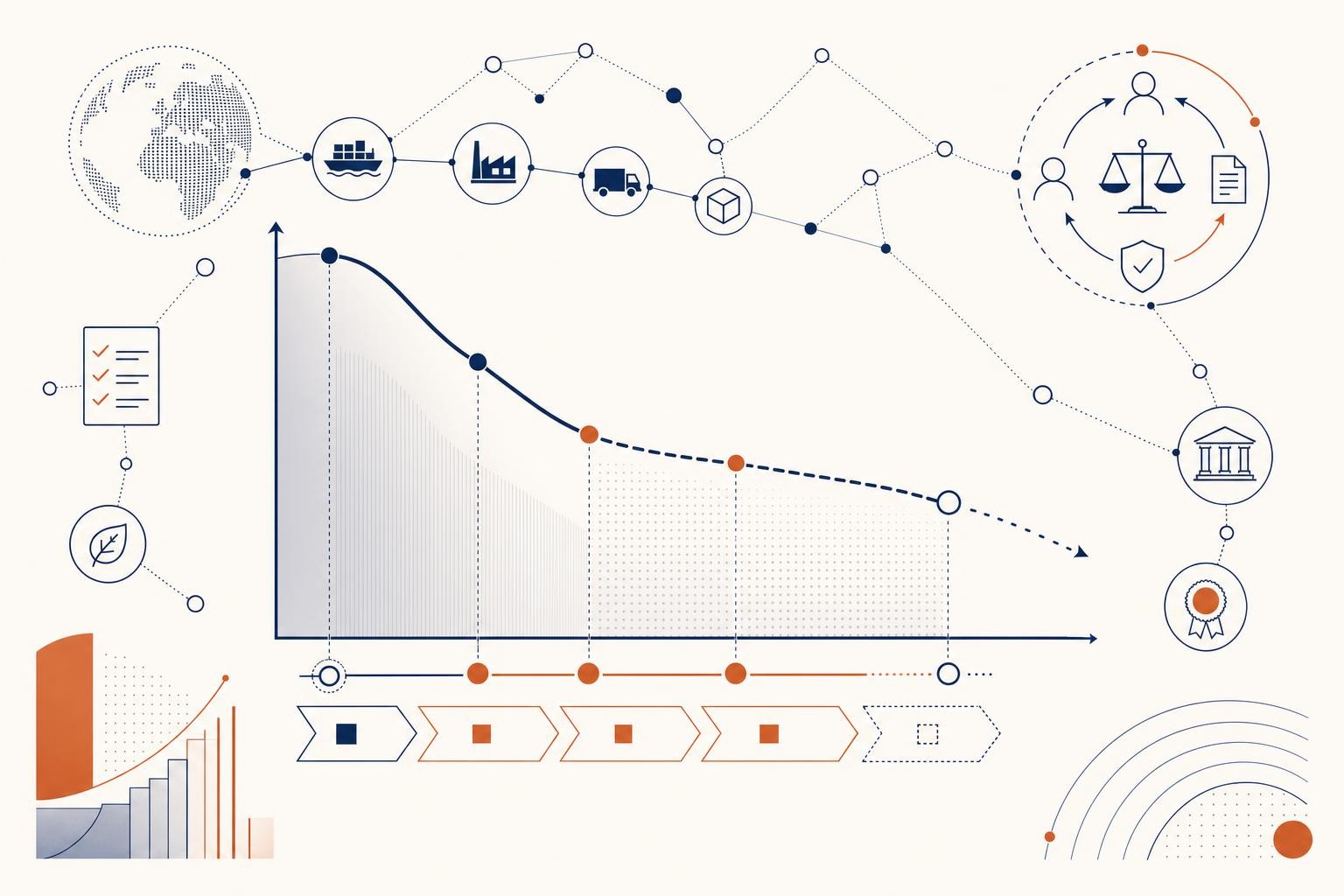
The CBAM Cost Curve Just Changed: What the Commission's July 2026 ETS Proposal Means for Your Import Budget
The Commission's 17 July 2026 ETS revision slows the CBAM phase-in and pushes full phase-out to 2038. Here's exactly what that does to your certificate bill - and what's still uncertain.