The CBAM Cost Curve Just Changed: What the Commission's July 2026 ETS Proposal Means for Your Import Budget
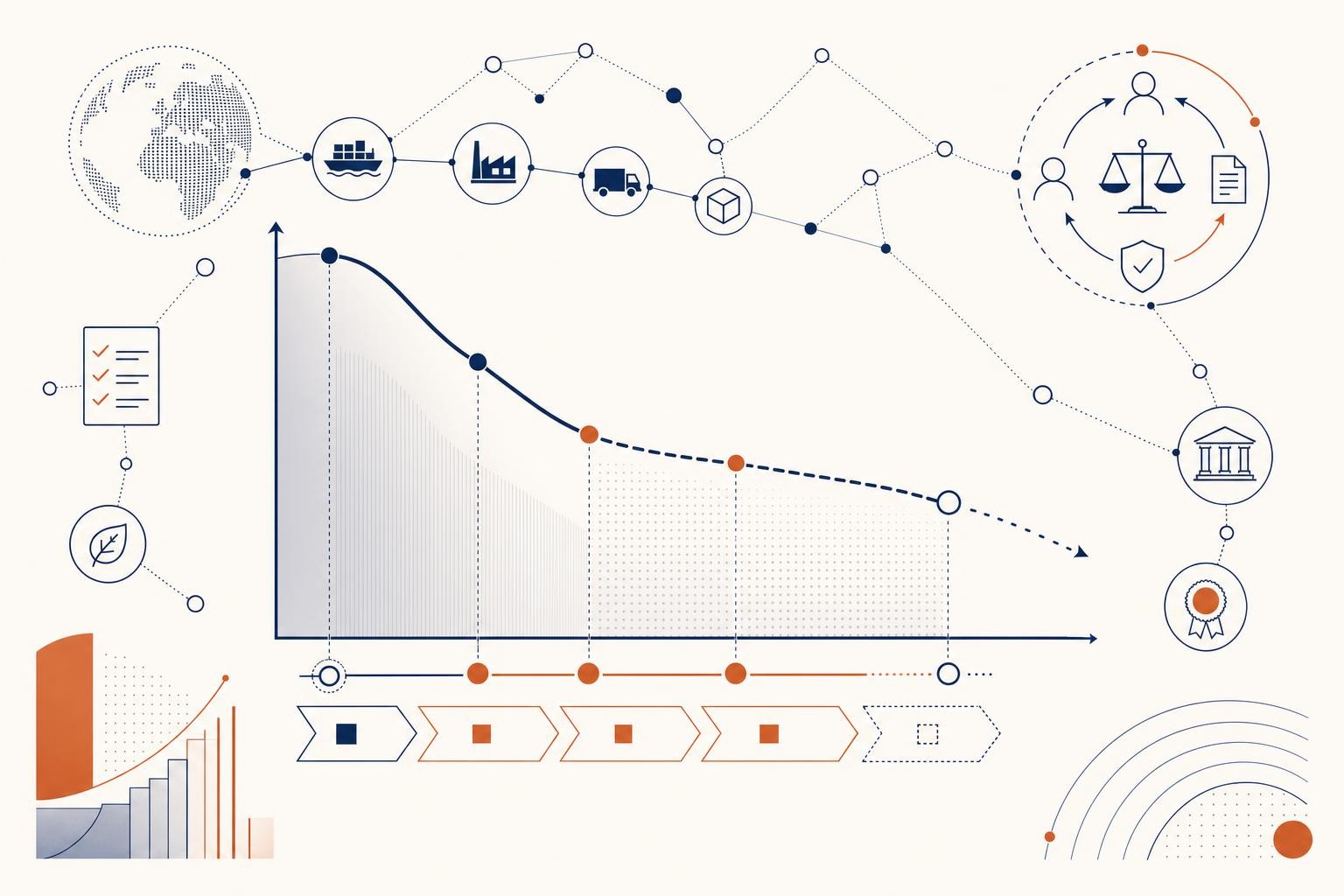
If you built a multi-year CBAM cost model based on the original 2026-2034 phase-out schedule, that model is now out of date. Not wrong - not yet law - but out of date.
On 17 July 2026, the European Commission published a targeted revision of the EU Emissions Trading System (EU ETS), presented alongside a new Electrification Action Plan. The headline for importers: the free allocation phase-out for CBAM sectors has been slowed, and the end date pushed from 2034 to 2038. Because the CBAM factor is mechanically linked to the free allocation schedule, a slower phase-out means a lower certificate obligation for longer - a meaningful change to the cost trajectory we covered in our earlier post on why 2026 is cheap and 2030 will hurt.
This piece is the update to that story. The trajectory has changed. Here is what changed, why it matters for your cost model, and what you should not yet treat as settled.
What the Commission Actually Proposed
On 17 July 2026, the European Commission published its proposal for a revised EU ETS, presented alongside a new Electrification Action Plan. The proposal follows intense political pressure from Member States for a wide-ranging review of the EU's flagship carbon pricing instrument against a backdrop of sustained high energy costs and a populist revival of climate change denial.
The Commission framed the revision around four pillars: boosting investment, providing relief to industry, maintaining a robust carbon market, and accelerating electrification. For CBAM purposes, the most consequential element is the change to the free allocation phase-out schedule.
The proposal slows the free allocation phase-out - and therefore the speed of the CBAM phase-in - by reintroducing 15% of the free allocation that would otherwise have been removed, starting in 2028, with the full phase-out completed by 2038.
In plain terms: while the phase-out of free allowances was initially planned for 2034, the Commission proposes reinstating 15% of free allocation from 2028, pushing the full phase-out back to 2038.
A separate benchmarks proposal, published the same day, goes further still: the Commission proposed increasing free allocation to industry worth €6 billion for the 2026-2030 period.
The CBAM Factor Link: Why This Directly Reduces Your Certificate Bill
This is the core mechanism that importers need to understand clearly.
The CBAM factor - the percentage of a product's embedded emissions that triggers a certificate obligation - is not set independently. It is the mirror image of the EU ETS free allocation phase-out. As long as EU domestic producers receive allowances at no charge, CBAM applies only to the fraction of emissions that are no longer covered by free allocation. The CBAM factor in any given year equals the percentage by which free allocation has been reduced.
Under the original schedule, free allocation for CBAM sectors was being reduced in annual steps from 97.5% remaining in 2026 down to 0% by 2034 - meaning the CBAM factor would have reached 100% in 2034. Current law leaves 51.5% of the benchmark-equivalent amount in 2030 and removes it completely from 2034. The proposal retains 59% in 2030 and 15% from 2034 through 2037, with the phase-out completed in 2038.
What that means in practice: importers would consequently surrender fewer certificates for the benchmark-equivalent part of embedded emissions if the revision were approved. Emissions above the applicable benchmark would remain exposed, so carbon-intensive production routes would continue to carry a larger CBAM cost than lower-emission alternatives.
The table below shows the key divergence between the original schedule and the proposed one:
| Year | Free Allocation Remaining — Original (%) | CBAM Factor — Original (%) | Free Allocation Remaining — Proposed (%) | CBAM Factor — Proposed (%) |
|---|---|---|---|---|
| 2026 | 97.5 | 2.5 | 97.5 | 2.5 |
| 2027 | 95.0 | 5.0 | 95.0 | 5.0 |
| 2028 | 90.0 | 10.0 | ~92.5 | ~7.5 |
| 2029 | 77.5 | 22.5 | ~80.0 | ~20.0 |
| 2030 | 51.5 | 48.5 | ~59.0 | ~41.0 |
| 2031 | 39.0 | 61.0 | ~50.0 | ~50.0 |
| 2032 | 26.5 | 73.5 | ~40.0 | ~60.0 |
| 2033 | 14.0 | 86.0 | ~30.0 | ~70.0 |
| 2034 | 0 | 100.0 | ~15.0 | ~85.0 |
| 2035 | — | — | ~15.0 | ~85.0 |
| 2036 | — | — | ~10.0 | ~90.0 |
| 2037 | — | — | ~5.0 | ~95.0 |
| 2038 | — | — | 0 | 100.0 |
Note: 2028-2037 proposed figures are indicative, derived from the Commission's stated 15% reintroduction from 2028 and the 2038 end-date. The Commission has not yet published a year-by-year table in the legislative text. Treat these as planning estimates, not confirmed values.
The 2026 and 2027 CBAM factor figures are unchanged under the proposal. The divergence begins in 2028. If your cost model only runs to 2027, the proposal has no immediate effect on your current obligations.
Free Allocation Becomes Conditional From 2031
The slower phase-out comes with strings attached - and those strings matter for EU manufacturers as much as for importers.
From 2031, free allocation becomes conditional on a verified "Invest in EU Decarbonisation Plan." Free allocation is split into two conditional stages: 80% granted up front once a company's decarbonisation plan is approved, and the final 20% released only after it proves the investments were made and delivered the promised emissions cuts.
Companies that relocate outside the EU will have to hand their allowances back.
This conditionality has a direct read-across to CBAM. If a significant number of EU producers fail to meet the investment conditions and lose part of their free allocation, the effective free allocation level - and therefore the CBAM factor - could diverge from the headline schedule. Finance teams modelling CBAM costs post-2031 should treat the conditional tranche as a variable, not a given.
EUROFER, the European Steel Association, warned that the new conditions attached to free allocation would increase administrative requirements and legal uncertainty, particularly where investment decisions depend on factors outside companies' direct control.
The Industrial Decarbonisation Bank: What It Is and What It Isn't
Alongside the revised phase-out schedule, the Commission has proposed a new funding architecture to support the transition.
The Commission has proposed creating an Industrial Decarbonisation Bank (IDB) backed by a €100 billion budget to fund emission-reduction projects in industry. The ETS Investment Booster programme, active until 2030, will launch the IDB's activities, offering roughly €30 billion in early-stage support for companies investing in decarbonisation.
To kick-start investment, the Commission plans to launch the ETS Investment Booster, backed by 400 million allowances. From 2031, it would be replaced by the Industrial Decarbonisation Bank, financed by an additional 400 million allowances, with an estimated total budget of €100 billion including the €30 billion from the booster.
For importers, the IDB is primarily relevant as context for why the Commission believes it can slow the CBAM phase-in without abandoning decarbonisation goals: the theory is that EU producers use the extended free allocation window to invest, supported by the IDB, rather than simply pocketing the relief. Whether that theory holds in practice will shape how quickly EU production actually decarbonises - and therefore how competitive imported goods remain on embedded-emissions grounds.
The Export Problem: Still Unresolved
CBAM protects EU producers from carbon-cost competition on imports. It does not help EU producers competing in export markets, where they face no equivalent carbon price protection. This asymmetry has been a persistent complaint from steel, aluminium, and cement associations.
CBAM was intended to equalise carbon costs at the border for imported goods but does not support EU exports. For export-heavy industries, the EU ETS therefore remains a strong push to offshore manufacturing.
EUROFER's Director General emphasised that the proposal fails to introduce the long-awaited structural solution for exports from sectors covered by CBAM.
The export compensation question is politically and legally fraught. If a measure looked like it was designed to prop up the international competitiveness of EU industry, that might be deemed an export subsidy, frowned on by the World Trade Organization (WTO).
Industries that export CBAM-covered products to destinations outside the EU lose free allowances as the phase-out proceeds. They pay for the costs of the ETS without enjoying any CBAM-style protection in their overseas markets. Without a mechanism to aid those exporters, "there is a real risk of production and emissions moving outside Europe rather than being reduced globally," said Axel Eggert, Director-General of EUROFER.
A temporary compensation fund route has been discussed in the legislative process, but the word "export" does not appear anywhere in the legal proposal for the Fund - and that is no coincidence. For now, the export leakage problem remains structurally unaddressed in the July 2026 proposal.
For EU manufacturers in CBAM sectors: the slower phase-out reduces your near-term ETS cost exposure, but the export competitiveness gap is not closed by this proposal. If your business model depends on export markets, the IDB and the conditional free allocation framework are the main policy levers available to you — not a direct export rebate.
What This Is - and What It Isn't
This is a Commission proposal. It is not law.
The Commission's proposal initiates the ordinary legislative procedure, through which the European Parliament and the Council would need to agree on a final text. EU leadership aims to reach agreement on the reform by the end of the first quarter of 2027.
The Council and Parliament are targeting political agreement by Q1 2027, with intense debate expected from September 2026 onwards.
That timeline is ambitious. The original ETS revision took over two years from Commission proposal to final adoption. The numbers in this proposal - the 15% reintroduction, the 2038 end-date, the 80/20 conditionality split - are all subject to amendment in Parliament and Council. The ENVI committee in Parliament has historically pushed for faster phase-outs; some Member States will push for slower ones. The final schedule could land anywhere between the current law and the Commission's proposal, or even beyond it in either direction.
Current CBAM obligations remain unchanged unless the European Parliament and Council adopt this proposal.
How to Treat This in Your Cost Model
The right response is not to rebase your model on the proposed schedule. It is to run scenarios.
Here is the practical guidance for finance and procurement teams:
- Keep current law as your base case. Until Parliament and Council reach agreement, the 2034 full phase-out remains the legally operative schedule. Your compliance obligations today are unchanged.
- Add the Commission proposal as a downside-cost scenario. If the proposal passes broadly as written, your certificate bill from 2028 onwards will be lower than current law projects. That is a potential saving, not a confirmed one.
- Model a negotiated midpoint. Given the political dynamics - Parliament likely pushing for faster phase-out, some Member States for slower - a compromise schedule is a plausible third scenario.
- Watch the 2031 conditionality closely. The conditional free allocation structure introduces a new variable post-2031 that does not exist in current law. If EU producers fail to meet investment conditions, the effective CBAM factor could be higher than the headline schedule suggests.
- Do not assume the ETS price stays flat. The proposal also modifies the Linear Reduction Factor and the Market Stability Reserve in ways that affect ETS price dynamics. A lower CBAM factor combined with a higher ETS price could produce a similar or larger certificate bill than a higher factor at today's price.
The Bottom Line
The Commission's July 2026 ETS revision is the most significant change to the CBAM cost trajectory since the regulation was adopted. If it passes broadly as proposed, the certificate bill for importers of steel, aluminium, cement, fertilisers, hydrogen, and electricity will be meaningfully lower from 2028 through 2037 than current law projects - with full phase-in delayed by four years to 2038.
But the proposal is entering a legislative process that will run at least into 2027, and the numbers will move. The export leakage problem remains unresolved despite sustained industry pressure. And the new conditionality on free allocation from 2031 introduces complexity that current models do not capture.
The right response is scenario planning, not model replacement. Build the Commission proposal in as a scenario. Keep current law as your base. And watch the trilogue negotiations carefully - the gap between those two scenarios is where your cost uncertainty now lives.
Related reading
The UK-EU ETS Linkage Negotiation: What It Means for CBAM Exemption - and When
UK goods entering the EU face CBAM charges today - with no carve-out. The only route to exemption runs through ETS linkage. Here's the state of that negotiation, what it would actually change, and how to plan under uncertainty.
CBAM's Missing Half: What the Temporary Decarbonisation Fund Means for EU Exporters
CBAM equalises carbon costs on imports but leaves EU exporters exposed as free allocation disappears. This post explains the export carbon leakage gap, the proposed Temporary Decarbonisation Fund, and what exporters should do now.

CBAM and Customs Special Procedures: Why Inward Processing Defers Your Obligation, Not Cancels It
Inward processing doesn't exempt you from CBAM - it defers it. Here's exactly when the obligation triggers, what data you need to hold, and who must be the authorised declarant.