CBAM's Missing Half: What the Temporary Decarbonisation Fund Means for EU Exporters
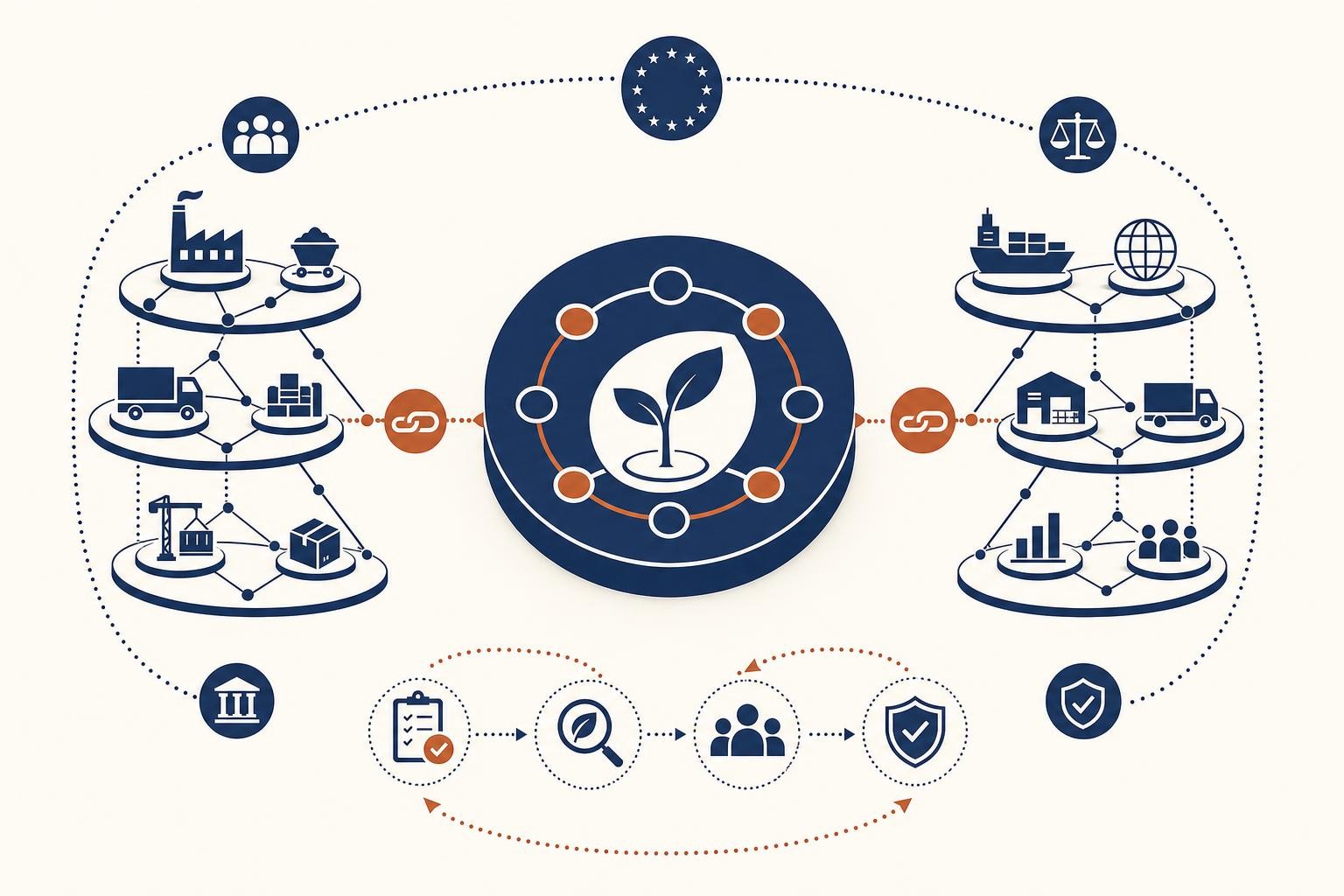
CBAM was designed to solve one half of the carbon leakage problem. It charges imported goods for the carbon their production emitted, so that a tonne of steel made in a country without a carbon price does not undercut a tonne made under the EU ETS.
It does nothing at all for the other half. When an EU producer sells into a third country, CBAM is irrelevant - and as free allocation under the ETS is withdrawn, that producer carries a carbon cost its competitors in that market do not. Economists call this export carbon leakage. EU industry calls it the reason to move the plant.
The Commission's answer is the Temporary Decarbonisation Fund. It is not an export rebate, it is smaller than industry asked for, and it is in the final stretch of the legislative process right now. Here is what is actually on the table.
The asymmetry, in numbers
The exposure is real but bounded. Roughly 40% of CBAM-covered EU exports go to trading partners that already price industrial emissions in some form, which limits the competitive gap in those markets. The remainder goes to markets with little or no carbon price, and that is where the phase-out of free allocation bites - analysis by Agora Industry on addressing exports under CBAM sets out the mechanics.
The volumes involved are a small share of EU industrial output. But they are concentrated in exactly the sectors CBAM covers - steel, aluminium, cement, fertilisers - and in firms whose export margins are thin enough that a carbon cost of tens of euros per tonne is decisive.
Why not just rebate exports?
An export rebate is the obvious symmetrical fix: charge carbon on the way in, refund it on the way out. Four options were seriously debated, and the German Environment Agency's assessment of export carbon leakage policy options is a good guide to why the obvious answer lost.
| Option | What it does | Main objection |
|---|---|---|
| Export rebate | Refunds the ETS carbon cost on exported goods | Looks like an export subsidy under WTO rules; removes the carbon price signal on exported production entirely |
| Export-linked free allocation | Keeps free allowances for the export share of output | Same environmental-integrity problem, and hard to reconcile with the agreed phase-out |
| Slower or sector-specific phase-out | Withdraws free allocation more gently for exposed sectors | Delays the whole decarbonisation incentive, not just the export part |
| Targeted decarbonisation support | Funds capital investment in cutting emissions | Does not close the immediate cost gap; slower to reach firms |
The environmental objection is the sharp one. A rebate means EU producers face no carbon price on everything they export - which, for some plants, is most of what they make. Carbon Market Watch has argued that this turns CBAM into a mechanism for exporting pollution rather than preventing leakage. The Commission chose the fourth option.
What the Temporary Decarbonisation Fund actually is
In December 2025 the Commission published a package with three parts: extension of CBAM to roughly 180 downstream products, anti-circumvention measures, and a legislative proposal for the Temporary Decarbonisation Fund.
As proposed, the fund is:
- Targeted, not universal. Support goes to EU producers of CBAM goods judged to face a particularly high residual risk of carbon leakage - not to every exporter.
- Temporary. Two years, aligned with the early phase of free allocation withdrawal, rather than a standing instrument.
- Modest. Reporting puts it at roughly €300 million a year. Treat that figure as indicative: it comes from the proposal stage and the final envelope is a matter for the legislative negotiation.
- Decarbonisation support, not compensation for output. The money is meant to fund emissions reduction, which is what keeps it distinguishable from a rebate.
Industry has not been quiet about the size. European Aluminium's position paper is a fair example of the sectoral view that the envelope is too small relative to the cost being absorbed.
Where it stands, as of early September 2026
This is a live file. The sequence so far:
- December 2025 - Commission publishes the CBAM package including the TDF proposal.
- 12 June 2026 - the Council agrees its position, with refinements to the Commission text.
- Early July 2026 - the European Parliament's ENVI committee adopts its position, backing both the downstream extension and the fund.
- September 2026 - plenary vote expected, after which trilogue negotiations between Parliament, Council and Commission determine the final text.
Nothing here is law yet. A committee position is not a Parliament position; a Parliament position is not an adopted regulation; and trilogue routinely changes numbers. If you are budgeting against this, verify the plenary outcome directly rather than working from the proposal.
The European Parliament's own briefing on the fund is the most reliable single document for tracking where the text has got to.
The criticism is worth taking seriously
Two lines of objection have real weight and deserve stating plainly rather than being waved through.
Design and impact. EU auditors have questioned how the fund is set up and whether it will achieve much at its proposed size - a fair challenge to any instrument that spreads a few hundred million euros across several heavy industries.
Price signal. Every euro of support for producers facing carbon costs slightly weakens the incentive the carbon price is there to create. The counter-argument is that a plant relocated outside the EU produces the same tonne of steel with higher emissions and no European jobs. Both arguments are coherent; where you land depends on how much weight you give relocation risk against the integrity of the price signal.
What exporters should do regardless of the outcome
The fund may be adopted at €300 million a year, at more, at less, or with eligibility criteria nobody has drafted yet. Four things are worth doing in every scenario, because all four are prerequisites for any support mechanism and all four are useful on their own.
Know your carbon cost per tonne of product, per market. Not at company level - at product level, for the specific goods you export and the specific markets they go to. Any eligibility test will be applied at something close to this granularity.
Map your free allocation entitlement to 2034. The phase-out schedule is known. Model what it does to your cost base year by year and identify the years where the gap becomes commercially decisive.
Build the emissions dataset now. Verified, installation-level, product-level emissions data is the price of entry for any support scheme, and it is the same dataset your EU customers need for their own CBAM obligations and your buyers need for their supply chain reporting. It is not wasted work if the fund shrinks.
Model your delivered price in non-priced markets. Where the carbon cost is genuinely decisive, the answer may be commercial - repricing, contract terms, or a different market mix - rather than waiting for Brussels.
What is still unknown
Honest list: the final size of the envelope; the eligibility criteria and how "particularly high risk" gets defined in practice; whether the two-year duration survives trilogue; how the fund interacts with the downstream scope extension in the same package; and whether any successor instrument follows when it expires.
The one thing that is not uncertain is the direction. Free allocation is going, the export gap is opening, and the EU has chosen to address it with targeted investment support rather than a rebate. Plan around that, and treat the fund as a possible contribution to your transition capital rather than as a hedge against your export cost curve.
Related reading
The UK-EU ETS Linkage Negotiation: What It Means for CBAM Exemption - and When
UK goods entering the EU face CBAM charges today - with no carve-out. The only route to exemption runs through ETS linkage. Here's the state of that negotiation, what it would actually change, and how to plan under uncertainty.
CBAM and Customs Special Procedures: Why Inward Processing Defers Your Obligation, Not Cancels It
Inward processing doesn't exempt you from CBAM - it defers it. Here's exactly when the obligation triggers, what data you need to hold, and who must be the authorised declarant.
The CBAM Cost Curve Just Changed: What the Commission's July 2026 ETS Proposal Means for Your Import Budget
The Commission's 17 July 2026 ETS revision slows the CBAM phase-in and pushes full phase-out to 2038. Here's exactly what that does to your certificate bill - and what's still uncertain.