CBAM 2026: Your Complete Compliance Guide for the Definitive Phase
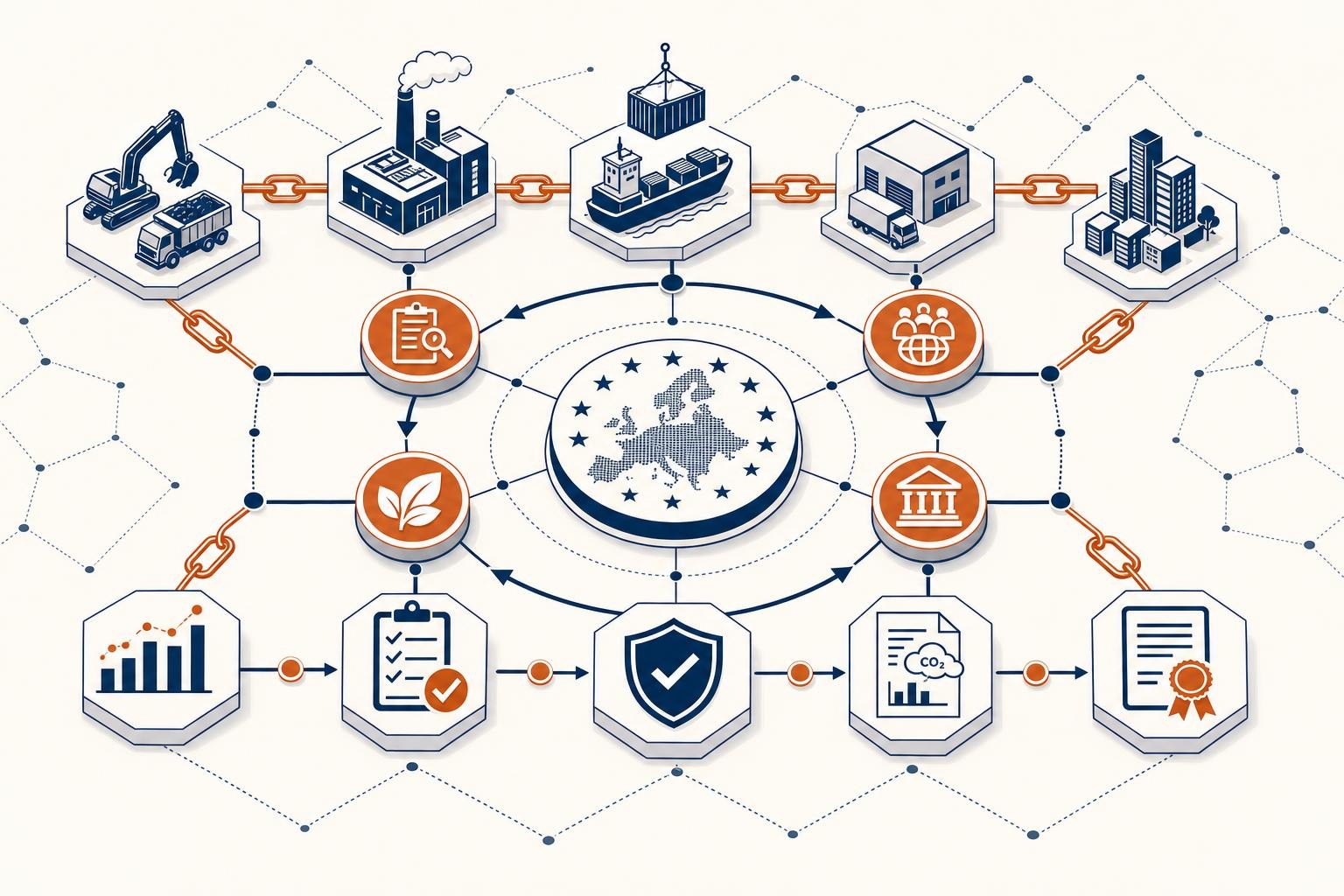
The EU Carbon Border Adjustment Mechanism stopped being a reporting exercise on 1 January 2026. From that date, importing steel, aluminium, cement, fertilisers, electricity, or hydrogen into the EU carries a real carbon cost - and real legal consequences if you get it wrong.
This guide explains what changed, who is in scope, and exactly what you need to do.
What changed on 1 January 2026
The CBAM definitive (compliance) phase began on 1 January 2026, ending the transitional reporting-only period that had run since October 2023. During the transitional phase, importers only had to submit quarterly emissions reports - no certificates, no financial obligation. That is now over.
The transitional reporting-only phase ran from October 2023 to December 2025. From 2026, financial obligations - including the purchase and surrender of CBAM certificates - apply to in-scope imports.
The shift matters because the data you collect throughout 2026 will directly determine what you owe in 2027. The financial obligation is retroactive - importers will purchase and surrender certificates in 2027 for goods imported throughout 2026. The emissions data being collected right now determines what those certificates will cost.
The 50-tonne threshold: are you in scope?
The biggest structural change introduced by the 2025 Omnibus simplification (Regulation (EU) 2025/2083) is a new de minimis rule.
A single mass-based de minimis threshold of 50 tonnes of CBAM goods per importer per calendar year replaced the old €150-per-consignment exemption. The previous €150-per-shipment trigger is replaced by a 50-tonne annual threshold per importer. Importers whose total yearly imports of CBAM goods (cement, fertilisers, iron and steel, and aluminium) do not exceed 50 tonnes are now exempt from CBAM reporting, declaration, and certificate-surrender obligations.
The new de minimis rule applies to imports of all CBAM goods except hydrogen and electricity. Those two sectors remain fully subject to CBAM regardless of volume.
According to the European Commission, the 50-tonne threshold exempts approximately 90% of importers while still capturing roughly 99% of embedded emissions covered by CBAM. According to the Commission, the new threshold exempts 90% of importers while still covering 99% of embedded emissions from CBAM-covered goods imported into the EU.
The "all or nothing" trap
This is the rule that catches importers off guard. The CBAM threshold operates on an "all or nothing" basis. Once the cumulative 50-tonne limit is exceeded at any point during a calendar year, full CBAM obligations apply to all relevant imports from 1 January of that year - not just to volumes above the threshold. This mechanism creates a significant regulatory risk, particularly for businesses with fluctuating or unexpectedly increasing import volumes.
In plain terms: a company that crosses 50 tonnes in November is treated as if it had full CBAM obligations since 1 January - without authorisation, without a declaration system, and without the required certificate holdings. Importers nearing the threshold should implement robust monitoring systems and assess whether voluntary early compliance may be a prudent strategy to mitigate the risk of exposure.
Three obligations if you are above the threshold
If your cumulative annual imports of CBAM goods exceed 50 tonnes (or you import electricity or hydrogen in any quantity), three core obligations apply.
You must obtain 'authorised CBAM declarant' status via your national competent authority (NCA) before your imports exceed the 50-tonne threshold. Applications are submitted through the CBAM Registry's Authorisation Management Module (AMM) and require a valid EORI number. The NCA assessment typically takes around 120 days. Importers who submitted their application by 31 March 2026 may continue importing while their authorisation decision is pending — but this grace window has now closed for new applicants. If you have not yet applied and expect to exceed the threshold, apply immediately.
You must collect verified greenhouse-gas emissions data for every CBAM import throughout 2026. Reporting has moved from quarterly to an annual cadence. You may use actual verified emissions from your supplier's installation, or EU default values published in Implementing Regulations (EU) 2025/2620 and 2025/2621 (note: default values carry a mark-up). Verification by an accredited verifier is only required when using actual values. The first annual CBAM declaration — covering all 2026 imports — is due by 30 September 2027.
Each CBAM certificate covers one tonne of CO₂-equivalent of embedded emissions. You do not buy certificates during 2026 itself — certificate sales on the EU central platform open on 1 February 2027. The price for 2026 imports is set as the quarterly volume-weighted average of EU ETS auction clearing prices during 2026. You must surrender the required number of certificates by 30 September 2027. From 2027 onwards, you must also hold certificates covering at least 50% of year-to-date embedded emissions at the end of each quarter.
Key dates at a glance
| Date | What happens | Who it affects |
|---|---|---|
| 1 Jan 2026 | Definitive phase begins — financial obligations live | All in-scope importers |
| 31 Mar 2026 | Deadline to apply for authorised declarant status and keep importing provisionally (now passed) | Importers above 50t threshold |
| Throughout 2026 | Collect verified embedded emissions data for all CBAM imports | Authorised declarants |
| 1 Feb 2027 | CBAM certificate sales open on EU central platform | Authorised declarants |
| 30 Sep 2027 | First annual CBAM declaration due + certificate surrender deadline for 2026 imports | Authorised declarants |
| 1 Nov 2027 | Commission cancels any unsurrendered 2026 certificates without compensation | Authorised declarants |
On 1 February 2027, the EU central platform opens for the sale of CBAM certificates, managed by the European Commission. By 30 September 2027, importers must submit the first annual CBAM declaration and surrender certificates for all 2026 imports. Certificates for 2026 must be purchased retroactively from 1 February 2027, priced at the average quarterly EU ETS price for 2026.
How much will it cost in 2026?
The financial exposure in 2026 is deliberately modest - but it escalates sharply over the decade.
In 2026, the CBAM factor is 2.5%, meaning importers only surrender certificates for 2.5% of their goods' embedded emissions. By September 30, 2027, EU importers will have to surrender CBAM certificates for 2.5% of the GHG emissions embedded in relevant goods imported in 2026. EU ETS free allocation for CBAM sectors reduces from 97.5% in 2026 to 0% by January 1, 2034, creating a nine-year cost escalation that transforms CBAM from a minor compliance cost into a defining competitive variable. The CBAM factor rises in nine steps, with the steepest single-year jump occurring between 2029 and 2030, when it increases from 22.5% to 48.5%.
The Q1 2026 CBAM certificate price was set at approximately €75.36 per tonne CO₂e. The first certificate price of €75.36 per tonne of CO₂e for Q1 2026 was published by the European Commission on 7 April 2026, tracking the EU Emissions Trading System (EU ETS) auction average.
The cost line that looks small today will be roughly 40 times larger by 2034 at the same carbon price, as the CBAM factor reaches 100%. Finance teams should model this trajectory now, not in 2030.
Penalties for non-compliance
The stakes are real. Under Regulation (EU) 2025/2083, the first annual certificate surrender is due by 30 September 2027. Authorised declarants who fail to surrender sufficient certificates by this date face a penalty of €100 per tonne of CO₂, indexed to the European inflation rate. Paying the fine does not exempt the declarant from the obligation to surrender the missing certificates.
The penalty is even steeper for importing without authorisation. If an importer exceeds the single mass-based threshold without authorised CBAM declarant status, penalties apply amounting to three-to-five times the standard penalty of EUR 100 per tonne of embedded emissions. That means up to €300-500 per tonne of CO₂e - on top of still needing to surrender the certificates.
The 'all or nothing' rule means late discovery is expensive. If you breach the 50-tonne threshold in, say, October 2026 without authorised declarant status, your full-year 2026 imports are retroactively in scope — and you face the elevated 3–5× penalty rate on all of them. Monitor your cumulative import tonnage across all CBAM CN codes throughout the year.
What to do now: a practical checklist
Use this as a starting point for your compliance review. Every importer's situation is different - this is not legal advice.
- Check your CN codes. Confirm which of your imported goods fall under CBAM Annex I. The six sectors are cement, iron and steel, aluminium, fertilisers, electricity, and hydrogen.
- Calculate your 2026 tonnage. Add up the net mass of all CBAM goods you have imported (or plan to import) this calendar year across all consignments and all suppliers.
- Determine your threshold status. If you import electricity or hydrogen in any quantity, you are in scope. For all other sectors, compare your total to 50 tonnes.
- Apply for authorised CBAM declarant status immediately if you are above (or approaching) the threshold and have not yet done so. The 31 March 2026 grace window has closed - you now need authorisation before your next import that would breach the threshold.
- Set up emissions data collection. For each CBAM import, record the country of origin, CN code, net mass, and embedded GHG emissions (actual or default values). This data feeds your 2027 declaration.
- Engage your suppliers. If you want to use actual (rather than default) emissions values - which may reduce your certificate cost - your non-EU supplier needs to provide installation-level data. Start those conversations now.
- Model your certificate cost. Estimate your 2026 embedded emissions × 2.5% CBAM factor × the quarterly ETS-linked certificate price. Build this into procurement budgets and, where possible, contract terms.
- Diary the key 2027 deadlines. Certificate sales open 1 February 2027. Declaration and surrender deadline: 30 September 2027.
Frequently asked questions
Does the 50-tonne threshold apply per shipment or per year?
Per importer, per calendar year — cumulative across all CBAM goods and all CN codes. A single large shipment of 60 tonnes puts you over the threshold for the whole year, as does ten shipments of 6 tonnes each.
I import both steel and aluminium. Do I get a separate 50-tonne allowance for each?
No. The threshold is aggregated across all CBAM goods (excluding electricity and hydrogen) per importer per year. Your steel and aluminium tonnages are added together.
I missed the 31 March 2026 application deadline. Can I still import?
You must apply for authorised CBAM declarant status before the import that would take you over the 50-tonne threshold. Importing above the threshold without authorisation triggers the elevated 3–5× penalty rate. Contact your national competent authority immediately.
Do I need to buy CBAM certificates in 2026?
No. Certificate sales on the EU central platform open on 1 February 2027. However, the financial liability for your 2026 imports accrues now — you will pay for them retroactively in 2027 at the quarterly average ETS price for 2026.
What is the difference between actual and default emissions values?
Actual values are installation-level emissions data verified by an accredited third-party verifier — they reflect your specific supplier's production process. Default values are EU-published benchmarks (with a mark-up of 10–30% depending on sector) that you can use without supplier data or verification. Default values are simpler but may result in a higher certificate cost; actual values require supplier engagement and verification but can reduce your liability if your supplier is cleaner than the benchmark.
Does CBAM apply to goods I import from countries with their own carbon pricing?
Potentially less so. If a verified carbon price has already been paid in the country of origin, the equivalent value can be deducted from your certificate surrender obligation. The deduction requires documented evidence and must meet EU recognition criteria.
Related reading
The UK-EU ETS Linkage Negotiation: What It Means for CBAM Exemption - and When
UK goods entering the EU face CBAM charges today - with no carve-out. The only route to exemption runs through ETS linkage. Here's the state of that negotiation, what it would actually change, and how to plan under uncertainty.
CBAM's Missing Half: What the Temporary Decarbonisation Fund Means for EU Exporters
CBAM equalises carbon costs on imports but leaves EU exporters exposed as free allocation disappears. This post explains the export carbon leakage gap, the proposed Temporary Decarbonisation Fund, and what exporters should do now.
CBAM and Customs Special Procedures: Why Inward Processing Defers Your Obligation, Not Cancels It
Inward processing doesn't exempt you from CBAM - it defers it. Here's exactly when the obligation triggers, what data you need to hold, and who must be the authorised declarant.