CBAM and Imported Electricity: Why the Physical Hourly PPA Is Now the Only Route Off the Default
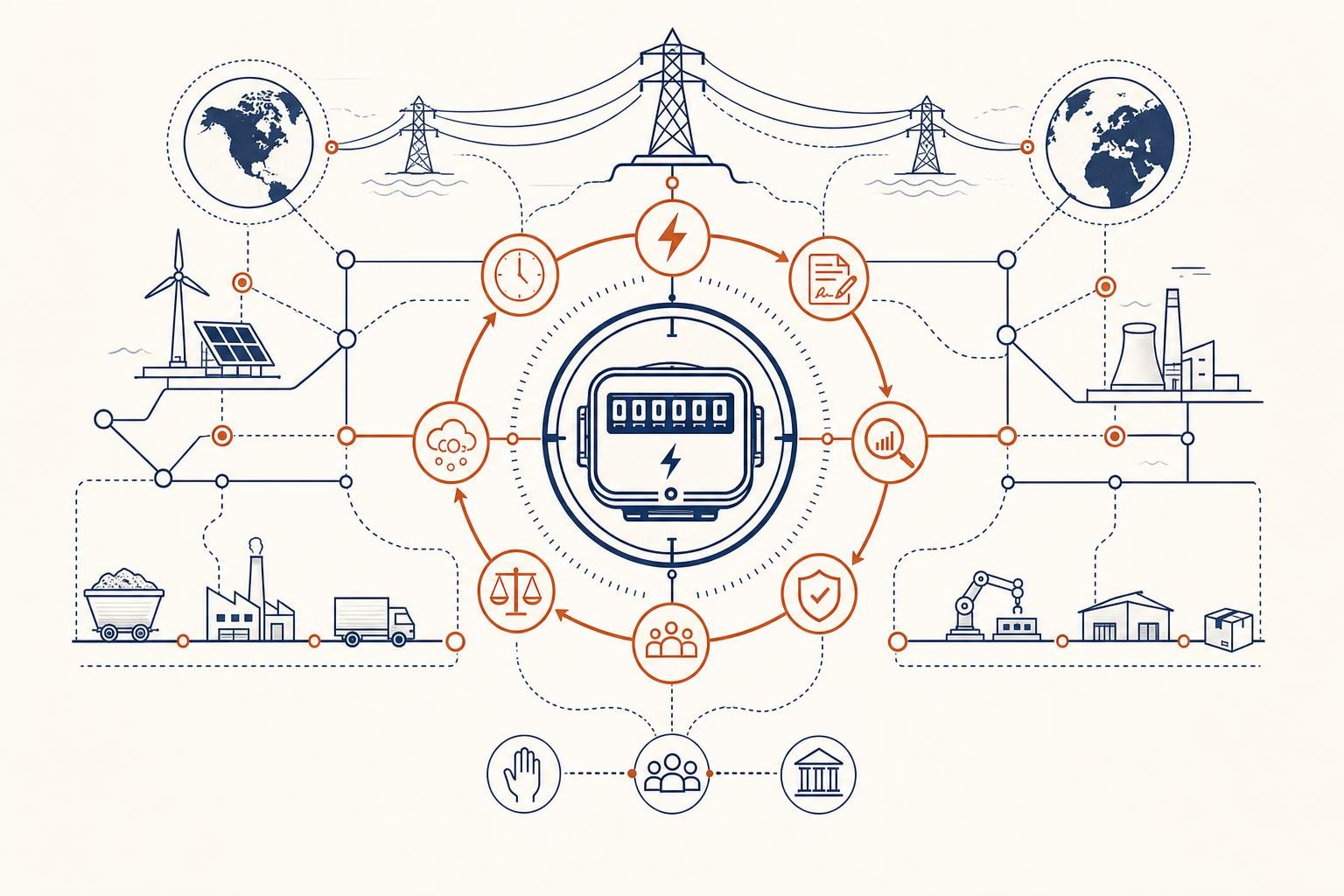
If you import electricity across an EU border, or trade cross-border power on behalf of utilities and energy companies, CBAM has been a live financial obligation since 1 January 2026. Not a reporting exercise. Not a rehearsal. Real certificates, real money.
But electricity is not just another CBAM sector. It is measured differently, declared differently, and - critically - the only path to a lower emissions figure is narrower and more demanding than almost anyone expected. This post goes deep on the mechanics that matter specifically for electricity importers, traders, and their compliance teams.
How electricity sits differently inside CBAM
CBAM covers six sectors: cement, iron & steel, aluminium, fertilisers, hydrogen, and electricity. For most of those sectors, the embedded emissions figure combines direct emissions (from combustion and industrial processes at the production installation) and, for cement and fertilisers, indirect emissions (from the electricity consumed during production).
Electricity is the exception. When you import electricity into the EU customs territory, CBAM charges only the direct emissions embedded in generating that electricity. There are no indirect emissions layered on top - the product is the electricity, so the question is simply: how carbon-intensive was the generation that produced the MWhs you imported?
This sounds simpler than steel or cement. In practice, it creates a very specific problem: you are being charged for the carbon content of a commodity that is physically indistinguishable once it enters the grid.
Electricity is declared in MWh, not tonnes. Under Article 6 of the CBAM Regulation, the annual declaration must show embedded emissions in tonnes of CO₂e per MWh — not per tonne of product as with other sectors. This affects how you structure your data collection and how you work with your transmission system operator (TSO) documentation.
The default: a whole-grid average, including renewables
When you cannot demonstrate the actual carbon intensity of the electricity you imported, you fall back on the default emission factor for the country of origin. These country-specific default values are set out in Annex III of Implementing Regulation (EU) 2025/2621, published on 31 December 2025 - one day before the definitive period began.
Implementing Regulation (EU) 2025/2621 was published on 31 December 2025, one day before the CBAM definitive period began on 1 January 2026.
The regulation contains three distinct sets of default values: one for direct emissions of non-electricity goods, one for indirect emissions of non-electricity goods, and a separate third set specifically for imported electricity. The electricity defaults in Annex III are calculated on the basis of the average yearly CO₂ emission factors for the most recent five-year period for which reliable IEA data is available.
Here is the key point: the grid average covers all generation sources - coal, gas, nuclear, wind, solar, hydro. If Norway exports electricity to the EU, the default factor reflects Norway's entire grid mix, which is predominantly hydro. If Poland exports, the default reflects Poland's coal-heavy mix. The default is not a fossil-fuel-only figure; it is a whole-system average.
Default emission factors for imported electricity under IR (EU) 2025/2621 are calculated as five-year averages of the country-of-origin grid's CO₂ intensity, based on IEA data, covering all generation sources.
This design creates a structural pressure on third-country producers: if your grid is dirty, your electricity exports carry a high default factor, and EU buyers pay more in CBAM certificates. The incentive to decarbonise the generation mix - or to prove you are using cleaner generation - is built in.
One more thing the default does not do: carry a mark-up. For non-electricity goods (steel, aluminium, cement), the default values in IR (EU) 2025/2621 include a compulsory mark-up - rising from 10% in 2026 to 30% by 2028 - designed to ensure defaults are not lower than actual emissions at a typical installation. Electricity defaults carry no such mark-up. The grid average is the grid average. This is one of the few places where electricity importers get a structural advantage over other sectors - but it is offset by the difficulty of escaping the default at all.
No de minimis exit: electricity is always in scope
Before going further, one point that catches electricity importers off guard: there is no de minimis threshold for electricity.
The Omnibus simplification (Regulation (EU) 2025/2083) introduced a 50-tonne mass-based de minimis exemption that removes the smallest importers from CBAM obligations. It exempts roughly 90% of importers while still covering 99% of embedded emissions. But hydrogen and electricity are explicitly carved out of this exemption.
Hydrogen and electricity are excluded from the 50-tonne de minimis exemption introduced by Regulation (EU) 2025/2083, meaning electricity importers are in scope regardless of volume.
For electricity, there is no minimum volume below which you are exempt. If you import any quantity of electricity across an EU border, you are an authorised CBAM declarant and you must account for the embedded emissions of every MWh. You cannot size your way out of this obligation.
The only route off the default: a physical hourly PPA
This is the central strategic question for every electricity importer: can you demonstrate that the electricity you imported was cleaner than the grid average, and therefore use a lower actual emission factor?
The answer is yes - but the conditions are strict, and most common renewable energy instruments do not qualify.
The regulation places physical, hourly delivery at the core of the actual-values route. To use an actual emission factor instead of the country default, you need contractual and metering evidence that ties specific clean generation to specific import volumes in the same hour. The key requirements include:
- A physical-delivery PPA covering the volume claimed, directly linking the authorised CBAM declarant to a third-country electricity producer
- Proof of direct connection to the Union transmission system, or an hourly no-congestion attestation
- Confirmation that the generating installation emits no more than 550g CO₂ (fossil) per kWh
- Cross-border nomination documentation across origin, destination, and transit TSOs
- Smart metering production data showing alignment to the nominated period, with a measurement period not exceeding one hour
- Monthly interim reporting to support accredited verification
The "not exceeding one hour" measurement period is the defining constraint. It is what makes this a physical hourly PPA requirement in practice, even if the regulation does not use that exact phrase as a defined term.
To use an actual emission factor for imported electricity under CBAM, smart metering production data must show alignment to the nominated delivery period with a measurement period not exceeding one hour.
What does NOT qualify
This is where many energy traders and compliance teams are caught out. The following instruments - widely used in corporate renewable energy procurement and Scope 2 accounting - are not accepted as proof of lower-carbon electricity under CBAM:
- Guarantees of Origin (GOs) - the standard European renewable energy certificate
- REGOs (UK equivalent)
- I-RECs or other unbundled Energy Attribute Certificates (EACs)
- Virtual PPAs (financial/synthetic PPAs with no physical delivery obligation)
- Annual renewable energy matching of any kind
The regulation is explicit: the ability to move away from default grid values depends on evidence of physical electricity delivery and how emissions are calculated, not on certificates or contractual claims alone. Buying GOs or signing a virtual PPA will not reduce your CBAM liability by a single certificate.
This is a significant departure from how most EU companies currently account for renewable electricity in their Scope 2 reporting or CSRD disclosures. CBAM does not replace or align with GHG Protocol Scope 2 accounting - it operates on a different evidentiary standard entirely.
The evolving picture: Commission signals flexibility
The current rules have attracted significant criticism from industry. Stakeholder feedback during the transitional period highlighted that the conditions for declaring actual emissions of electricity have proven to be "almost impossible" to meet in practice, and that the framework does not sufficiently acknowledge progress made by non-EU electricity producers in decarbonising their generation mixes.
In response, the European Commission has proposed amendments to the CBAM Regulation specifically targeting electricity. The proposal - part of a broader legislative package that also addresses downstream scope expansion and anti-circumvention - aims to improve the technical rules for attributing emissions to electricity imports, with the stated goal of encouraging decarbonisation.
One notable proposed clarification: while PPAs must be physical (not virtual), certain PPAs concluded between intermediaries may be used, not just direct producer-to-declarant contracts. This would be of particular benefit to countries neighbouring the EU - including the UK and the Western Balkans - where electricity trading typically flows through intermediary structures.
The European Commission has proposed amendments to the CBAM Regulation to improve technical rules for attributing emissions to imported electricity, with changes proposed to apply from 1 January 2026 once adopted.
Important caveat: this proposal is still moving through the ordinary legislative procedure - it requires agreement between the European Parliament and the Council. The resulting amendments may differ substantially from what has been proposed, and the process may take considerable time. The current rules in IR (EU) 2025/2547 and IR (EU) 2025/2621 remain in force in the meantime.
The Commission has also signalled that technical adjustments will be made to facilitate market coupling for Energy Community countries when they are ready, potentially providing an exemption pathway for some neighbouring countries. Serbia, for example, has announced plans to implement CO₂ measurement, reporting, and verification standards - a step that could eventually support such an arrangement.
What this means in practice: a comparison
| Factor | Default route (grid average) | Actual values route (physical hourly PPA) |
|---|---|---|
| Emission factor used | Country grid average — all sources, 5-year IEA average (Annex III, IR 2025/2621) | Actual generation-specific factor, verified by accredited third party |
| Mark-up applied? | No mark-up for electricity | No mark-up (actual values used directly) |
| Evidence required | None — applies automatically | Physical PPA + TSO nominations + hourly metering + ≤550g CO₂/kWh threshold + monthly reporting |
| GOs / REGOs / virtual PPAs accepted? | N/A (default applies regardless) | No — explicitly excluded |
| Third-party verification required? | No | Yes — accredited verifier under CBAM framework |
| Viable for most importers today? | Yes — the automatic fallback | Only where physical hourly infrastructure exists |
| Risk if grid is coal-heavy | High CBAM certificate cost | Potentially much lower cost if clean generation can be proven |
Practical takeaways for electricity importers and traders
1. Know your default factor before your next import. Look up the Annex III default for your country of origin in IR (EU) 2025/2621. Multiply it by your expected import volume in MWh and by the current CBAM certificate price (€75.36/tCO₂e for Q1 2026) to get a rough cost estimate. That is your baseline liability.
2. Assess whether a physical hourly PPA is feasible for your supply. For most electricity traders buying from the spot market or through standard bilateral contracts, the physical hourly PPA route will not be available without significant restructuring of supply arrangements. Be honest about this early - do not assume that existing GO purchases or virtual PPA structures will help.
3. Do not conflate CBAM with Scope 2 accounting. GOs and virtual PPAs remain valid for GHG Protocol market-based Scope 2 reporting and CSRD disclosures. They simply do not reduce CBAM certificate liability. You may need to maintain two parallel frameworks for the same electricity volumes.
4. Watch the legislative process on electricity amendments. The Commission's proposed changes to the electricity rules are the most significant near-term development for this sector. If intermediary PPAs are formally recognised and the evidence requirements are eased, the actual-values route becomes more accessible. Subscribe to updates - this is an area where the rules could shift materially before your first annual declaration is due.
5. Remember: your first declaration is due 30 September 2027 - covering all 2026 imports. The data you collect now, including TSO nominations, metering records, and any PPA documentation, will form the evidence base for that declaration. Start the paper trail today.
No de minimis, no exceptions. Unlike steel or aluminium importers who may fall below the 50-tonne threshold, electricity importers are in scope for every MWh. If you are an authorised CBAM declarant importing electricity, there is no volume floor below which you can stop tracking embedded emissions.
The electricity rules under CBAM are genuinely harder to navigate than those for most other sectors - not because the maths is complex, but because the evidentiary bar for escaping the default is so high, and the instruments that most energy companies already use for renewable procurement simply do not count. The physical hourly PPA requirement is not a technicality; it is the central design choice, and understanding it is the starting point for any serious compliance or cost-reduction strategy.
Related reading
The UK-EU ETS Linkage Negotiation: What It Means for CBAM Exemption - and When
UK goods entering the EU face CBAM charges today - with no carve-out. The only route to exemption runs through ETS linkage. Here's the state of that negotiation, what it would actually change, and how to plan under uncertainty.
CBAM's Missing Half: What the Temporary Decarbonisation Fund Means for EU Exporters
CBAM equalises carbon costs on imports but leaves EU exporters exposed as free allocation disappears. This post explains the export carbon leakage gap, the proposed Temporary Decarbonisation Fund, and what exporters should do now.
CBAM and Customs Special Procedures: Why Inward Processing Defers Your Obligation, Not Cancels It
Inward processing doesn't exempt you from CBAM - it defers it. Here's exactly when the obligation triggers, what data you need to hold, and who must be the authorised declarant.