CBAM Embedded Emissions: How to Calculate Your Liability and Why Actual Data Beats Default Values
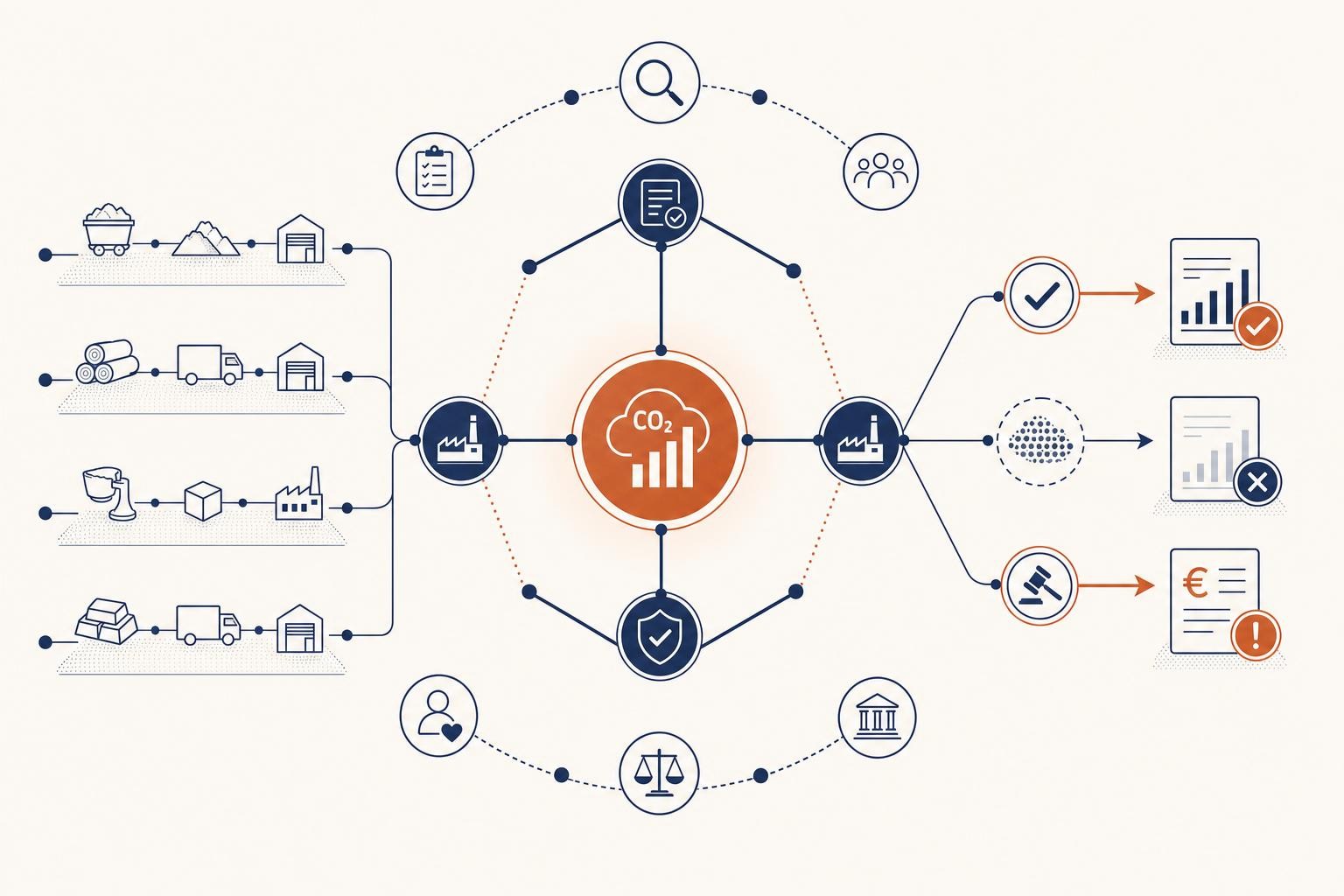
Every euro of CBAM liability starts with a single number: the specific embedded emissions (SEE) of your imported goods, expressed in tonnes of CO₂e per tonne of product. Get that number right - using real, verified data from your supplier - and your certificate obligation follows cleanly. Rely on the Commission's published fallback figures instead, and you pay a surcharge that grows every year. This guide explains the mechanics, the maths, and what to do before the September 2027 deadline.
What "embedded emissions" actually means
Embedded emissions (the regulation calls them specific embedded emissions) are the greenhouse gases released during the production of a good at the manufacturing installation - not during shipping, not during use. The system boundary ends at the factory gate.
The number that matters in every CBAM declaration is specific embedded emissions (SEE): the tonnes of CO₂e emitted per tonne of goods produced, expressed as a single figure at the level of the production installation.
Depending on the sector, SEE covers:
- Direct emissions - from combustion and process reactions at the installation (all six CBAM sectors).
- Indirect emissions - from the electricity consumed during production (relevant for aluminium, some steel and fertiliser products).
Transport and logistics emissions between the production installation and the EU border are not included in CBAM embedded emissions. The system boundary ends at the production installation gate.
The definitive phase: what changed on 1 January 2026
From 1 January 2026, the EU CBAM enters its definitive phase: importers of CBAM goods must ultimately declare embedded emissions and surrender CBAM certificates corresponding to those emissions (after applicable reductions).
After a transitional three-year reporting-only phase, the CBAM's financial obligations took effect on January 1, 2026. Importers are now required to purchase certificates to cover the carbon cost of their EU imports based on the prevailing price of emissions allowances under the EU Emissions Trading System (ETS).
The key dates to lock in:
- Throughout 2026 - collect installation-level emissions data from every supplier.
- From 1 February 2027 - sales of CBAM certificates through the EU's central platform begin, covering emissions from 2026 imports.
- 30 September 2027 - CBAM certificates for 2026 must be purchased and surrendered.
The September 2027 deadline is not a reporting deadline alone — it is the date by which you must have purchased and surrendered certificates covering every tonne of embedded emissions in your 2026 imports. Certificate sales only open in February 2027, leaving a seven-month purchase window.
The cost formula
Your gross CBAM cost in any year is roughly:
Gross cost = Import volume (t) × Embedded emissions (tCO₂e/t) × ETS certificate price (€/tCO₂e) × CBAM factor
Then subtract any carbon price already paid in the country of origin.
Breaking down each element:
1. Embedded emissions (tCO₂e/t) - either your supplier's verified actual figure, or the Commission's default value for that country and product (see below).
2. ETS certificate price - on 7 April 2026, the European Commission set the price of CBAM certificates for the first quarter of 2026 at €75.36, calculated according to the average weekly price of EU ETS allowances. For 2026 imports, four quarterly prices are published; from 2027 the price is set weekly.
3. CBAM factor - this reflects the phase-out of free EU ETS allocation. In 2026 the CBAM factor is 2.5%, meaning importers only need certificate coverage for 2.5% of embedded emissions. The free-allocation factor drops steadily: 97.5% in 2026, 95% in 2027, and then accelerating through 2030 (51.5%) until it reaches zero in 2034. What looks like a modest line item today becomes a material P&L exposure by the end of the decade.
4. Carbon price deduction - if a verified carbon price has already been paid in the country of origin, the equivalent value can be deducted from the importer's certificate surrender obligation.
Two ways to calculate CBAM embedded emissions
Importers have two options to determine embedded emissions: actual values that reflect the specific production conditions at the installation for manufacturing the CBAM goods (monitored and verified in line with IR 2025/2547 and IR 2025/2546); or default values as the goods-specific average emissions intensity in the country of origin with a mark-up, set by the EU Commission in IR 2025/2621.
Option 1: Actual verified data (preferred)
Actual data comes from the supplier's own monitoring plan - fuel consumption, process emissions, electricity use - calculated at installation level and then allocated to the specific goods produced. The calculation follows a top-down approach as defined in IR 2025/2547: emissions are monitored at installation level, then attributed to production processes, and then converted to specific embedded emissions for the goods produced.
Importers may report verified actual values or default values published by the Commission. Verification by an accredited verifier is required only when using actual values.
Once the definitive phase kicks in, the rules tighten considerably. CBAM declarants will only be permitted to report actual emissions data from their non-EU suppliers if it has been verified by an accredited verifier.
Option 2: Commission default values (fallback only)
The Commission publishes default values in Implementing Regulation (EU) 2025/2621 for each country and product category. The importer applies the relevant default value, adjusted with the applicable mark-up (10% in 2026, 20% in 2027, 30% from 2028).
Country-specific default values for specific embedded emissions of non-electricity CBAM goods are set in Annex I of EU IR 2025/2621. They represent the average emission intensity of each exporting country and for each CBAM good based on the most up-to-date and reliable information.
The definitive period introduces accredited third-party verification requirements exclusively to importers reporting with actual emissions data. Importers relying on default values are not subject to verification. That sounds convenient - but the financial penalty more than offsets the administrative saving.
Why default values cost more - and keep getting worse
The markup on default values is a deliberate policy lever, not a rounding error.
Default values carry a markup of 10% in 2026, 20% in 2027, and 30% from 2028 onward - except for fertilisers, where the markup is only 1% due to the complexity of obtaining actual data across chemical supply chains.
Default values will be increased by a 10% markup in 2026, rising to 30% by 2028, to encourage importers to use actual data instead of relying on the default values. For aluminium, cement, and iron & steel the mark-up increases from 10% in 2026 to 30% in 2028. Due to the difficulty of obtaining actual data across complex chemical supply chains, it is set at only 1% for fertilizer.
Beyond the markup, default values are set conservatively. These defaults are typically set at highly carbon-intensive levels to act as a financial penalty for limited transparency. For example, a Turkish cement producer may report verified emissions of around 0.88 t CO₂ per tonne, while the default clinker intensity is set at 1.52 t CO₂ per tonne. That difference can translate into a cost gap of ~$58 per tonne.
The CBAM Guide's worked example makes the arithmetic concrete: at the current EU ETS price of approximately €75/tCO₂, the gross CBAM cost on verified actual data for a Turkish Portland cement plant is 0.799 × €75 = €59.93 per tonne of cement. Using the default value instead would yield 0.83 × €75 = €62.25 per tonne, plus the 10% mark-up in 2026 (= €68.48 per tonne).
That gap widens every year as the markup ratchets up and the CBAM factor phases in. Actual verified data almost always produces a lower certificate obligation than default values for producers using modern, efficient technology. The financial case for investing in monitoring systems and third-party verification is already present in 2026 and becomes compelling post-2028.
The verification requirement explained
From 2026 onwards, data reported in your CBAM declaration will also need to be verified by an accredited external verifier.
Verification follows EU ETS-level standards. Verification must be performed by accredited CBAM verifiers in line with the principles in Implementing Regulation (EU) 2025/2546, using a risk-based approach similar to the EU ETS.
One of the most significant requirements for 2026 is the mandatory physical site visit at every installation producing CBAM goods. This creates a practical bottleneck: since facilities cannot calculate their 2026 emissions until year's end and importers must submit their 2026 CBAM data by September 2027, long verification queues seem likely.
National accreditation bodies are expected to open CBAM accreditation schemes until May 2026, with a tentative timeline for the first accreditations issued by late 2026. Several internationally operating verification bodies already accredited under the EU ETS will likely be the first official verifiers accredited for the CBAM scope.
The practical implication: if your suppliers have not already engaged a verifier, the clock is running.
Estimating your exposure: use the calculator
Before you can act, you need a rough number. The widget below lets you model your 2026 CBAM cost under both actual and default emissions scenarios - so you can see the financial case for supplier engagement in your own terms.
Practical checklist: getting supplier data and verification in place
The number of certificates you must surrender is determined by the embedded emissions of those goods. That number depends entirely on the quality of the data your suppliers provide. For most importers, supplier data collection is the single biggest operational challenge standing between them and a compliant CBAM declaration.
List every supplier installation producing goods you import under CBAM CN codes. You need installation-level data — not company-level ESG reports. Generic scope 3 LCAs do not meet CBAM's requirements.
The EU provides a standardised supplier communication template. Request: production route, fuel and energy consumption data, system boundaries per Annex II of the CBAM Regulation, and any precursor emissions. Set a clear deadline — verifiers need the full 2026 calendar year of data before they can begin.
Actual values must be monitored according to IR 2025/2547. If your supplier has no monitoring plan, they cannot produce compliant data for 2026 — and you will fall back to default values for that installation.
Verifiers must be accredited under IR 2025/2546. Accreditation pipelines are still opening in 2026. Engage a verifier — or confirm your supplier has done so — well before year-end. Physical site visits are mandatory for the first verification period.
Verification reports for 2026 can be issued via the CBAM Registry from January 2027. Collect the report, confirm it covers the full calendar year 2026, and check verifier credentials before including the data in your annual declaration.
Purchase certificates from the central platform (open from 1 February 2027) and surrender them alongside your annual declaration. Certificates are priced at the quarterly average ETS price for the relevant import quarter.
The bottom line
The embedded emissions figure you put in your CBAM declaration is not a compliance formality - it is the direct input to your certificate bill. Get it wrong, or default to the Commission's published fallback values, and you pay a penalty surcharge of 10% in 2026, rising to 30% from 2028 onward.
In the absence of actual data from the manufacturers of CBAM goods, importers can rely on default values. However, where production installations operate more efficiently than the country average, using actual emissions data can significantly reduce carbon cost exposure.
The verification timeline is tight. If suppliers cannot provide verified CBAM emissions data by 30 September 2027, importers must report using default values, which are typically significantly higher. The time to act is now - while 2026 data is still being generated and verifier capacity is still available.
Do I need verification if I use default values?
No. Verification by an accredited third party is only required when you report actual emissions data. If you use the Commission's published default values, no verification is needed — but you will pay the applicable markup (10% in 2026, rising to 30% from 2028 for most sectors).
What if my supplier refuses to provide emissions data?
You must fall back to the Commission's default values for that installation. Default values do not require the producer's cooperation. However, given the growing markup, it is worth making the financial case to your supplier: lower verified emissions reduce your certificate cost, which may allow you to pass savings back through the supply chain.
Can I use a mix of actual and default values across different suppliers?
Yes. You can use actual verified data for some installations and default values for others. Each installation is treated separately. Where actual data is available and verified, use it — the cost saving compounds over time as the markup ratchets up.
When can I buy CBAM certificates for my 2026 imports?
Certificate sales open on 1 February 2027 via the EU's central platform. Certificates must be surrendered by 30 September 2027. The price for 2026 imports is based on the quarterly average EU ETS allowance price for each quarter of 2026 — the Q1 2026 price was set at €75.36/tCO₂e.
Does the carbon price my supplier already paid abroad reduce my CBAM bill?
Yes — if a verified carbon price was paid in the country of origin (for example, under a domestic ETS or carbon tax), the equivalent amount can be deducted from the number of CBAM certificates you must surrender. The deduction applies only to importers using actual verified data, not default values.
Related reading
The UK-EU ETS Linkage Negotiation: What It Means for CBAM Exemption - and When
UK goods entering the EU face CBAM charges today - with no carve-out. The only route to exemption runs through ETS linkage. Here's the state of that negotiation, what it would actually change, and how to plan under uncertainty.
CBAM's Missing Half: What the Temporary Decarbonisation Fund Means for EU Exporters
CBAM equalises carbon costs on imports but leaves EU exporters exposed as free allocation disappears. This post explains the export carbon leakage gap, the proposed Temporary Decarbonisation Fund, and what exporters should do now.

CBAM and Customs Special Procedures: Why Inward Processing Defers Your Obligation, Not Cancels It
Inward processing doesn't exempt you from CBAM - it defers it. Here's exactly when the obligation triggers, what data you need to hold, and who must be the authorised declarant.