How to Get Authorised CBAM Declarant Status: A Step-by-Step Registry Guide
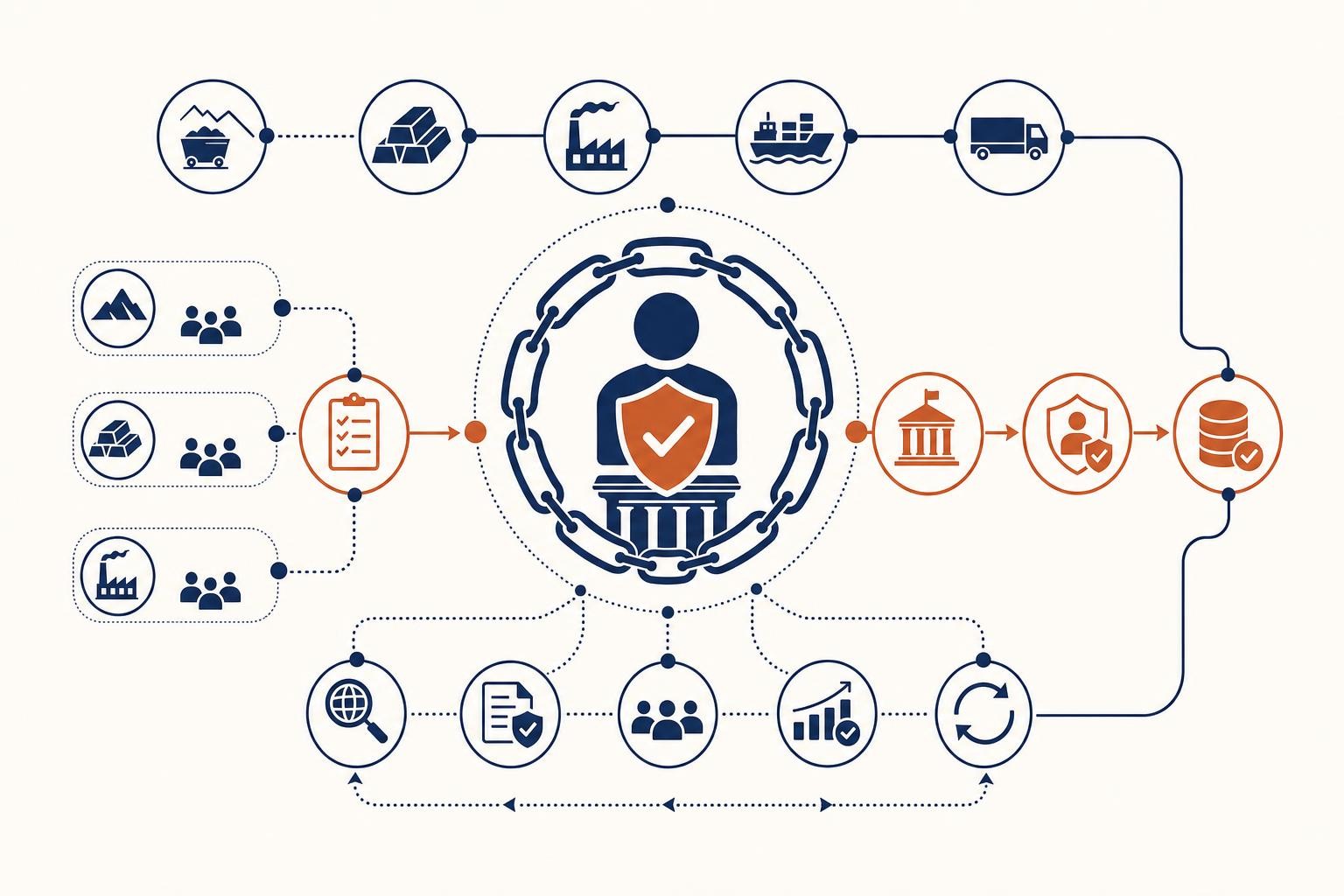
If your company imports steel, aluminium, cement, fertilisers, hydrogen, or electricity into the EU, one question now sits above all others: are you an authorised CBAM declarant?
From 1 January 2026, only importers holding authorised CBAM declarant status may bring CBAM-covered goods into EU customs territory. This isn't a reporting obligation you can catch up on later - it's a gate. Without the status, your goods can be blocked at the border, and penalties for unauthorised imports run at three to five times the standard €100-per-tonne rate.
This guide walks you through the mechanics: who needs to apply, how the CBAM Registry application actually works, what your National Competent Authority (NCA) will ask for, and what happens once you're approved.
Step 0: Do You Actually Need to Apply?
Before you open the CBAM Registry, do a quick scope check. The Omnibus simplification (Regulation (EU) 2025/2083) introduced a single mass-based de minimis threshold: importers whose cumulative annual imports of CBAM goods remain below 50 tonnes per calendar year are largely exempt from the authorisation requirement.
Two important caveats:
- Hydrogen and electricity are never exempt - the 50-tonne threshold does not apply to these two sectors regardless of volume.
- The threshold is cumulative across all CBAM goods, not per product line. A company importing 30 tonnes of steel profiles and 25 tonnes of aluminium extrusions is over the line.
The application for authorised CBAM declarant status must be submitted before the date of the import on which the 50-tonne threshold is exceeded. Don't wait until year-end to check your running total.
Why Authorisation Is Now Mandatory
During the transitional phase (October 2023 - December 2025), any importer could bring in CBAM goods - the obligation was purely to report embedded emissions quarterly. The definitive phase changed that entirely.
The CBAM Definitive Registry, developed by the Commission to help importers perform and report their CBAM obligations, requires importers of CBAM goods - or their indirect customs representatives - to apply for authorised CBAM declarant status.
Authorisation as a CBAM declarant results in CBAM rights - the ability to import goods into the EU - and obligations, including purchasing CBAM certificates for the embedded emissions in imported goods.
One point that catches people out: registration or login in the CBAM Registry does not constitute authorisation as a CBAM declarant and should not be confused with it. Authorisation is a separate procedure requiring an explicit application in accordance with Article 5 of the CBAM Regulation.
Who Needs to Apply
Authorisation is mandatory for two specific groups: EU importers - any entity established in the EU importing CBAM-covered goods above the 50-tonne de minimis threshold - and indirect customs representatives, who are required for non-EU importers and must be authorised from the very first import.
Your application is filed in the member state where you are established, not where the goods enter the EU. A German importer bringing steel through Rotterdam applies to the German NCA (DEHSt), not the Dutch one.
Authorised declarants may delegate the filing of CBAM declarations to EU-established third parties holding an EORI number, but remain responsible for compliance.
The CBAM Registry Application: Step by Step
The Authorisation Management Module (AMM) inside the CBAM Registry opened for applications on 31 March 2025. The process is fully digital.
Before touching the Registry, identify and contact your NCA — the body in your member state responsible for processing CBAM authorisations. The European Commission publishes a full, regularly updated list of NCAs on the DG TAXUD website. Your NCA will confirm access credentials and any member-state-specific requirements. In Germany, for example, the NCA is DEHSt (Deutsche Emissionshandelsstelle).
Access to the CBAM Registry runs through the EU Customs Trader Portal. You will need a valid EU Login account and an active EORI (Economic Operators Registration and Identification) number — a prerequisite for all applicants. Some member states have additional portal requirements (Germany requires an ELSTER certificate for customs portal access).
Log in to the Customs Trader Portal, open the CBAM Registry, navigate to Authorisation Management Module → New authorisation, and begin filling in the on-screen form.
The form covers three main areas: - Stakeholder details: legal name, registered address, EORI number, contact persons, ownership structure. - Activity details: which CBAM goods you import, expected annual volumes by CN code, supply-chain description. - Financial and operational details: legal status and size of entity, financial statements, compliance procedures, and the CV of the responsible person.
Attach PDFs of: recent balance sheets (typically the last three years of audited accounts), an internal procedure manual for CBAM compliance, a self-declaration of no serious customs or tax infringements in the last three to five years, and any bank guarantee if required. Newer businesses (established less than two years ago) may be asked to provide a financial guarantee — the NCA calculates the amount and gives a 60-day window to provide it.
Submit the application. Track its progress under 'My authorisations' in the portal. If the NCA requests additional information, you typically have 30 days to respond — the assessment clock pauses in the meantime. The final decision arrives in your portal inbox.
NCA requirements vary by member state. The core application form is EU-wide, but supporting document requirements differ. For example, the format of tax compliance certificates and the depth of financial-capacity evidence vary country by country. Always check your own NCA's published guidance before you start gathering documents.
What the NCA Assesses
NCAs are checking three things:
| Criterion | What they look for |
|---|---|
| Legal standing | Valid EORI, no serious customs/tax/market-abuse violations in the last 3-5 years |
| Financial capacity | Solvency, no significant tax arrears, ability to cover CBAM certificate liabilities |
| Operational capacity | Internal controls, data systems for emissions reporting, clearly assigned compliance responsibilities |
NCAs initiate a consultation procedure with other member states and the EU Commission no later than 45 days after receipt of the application, checking whether there are any objections to the authorisation. If there are no responses, the authorisation criteria are deemed to have been fulfilled.
The 120-Day Timeline and Provisional Imports
The standard assessment period for CBAM authorisation applications is up to 120 days. Applications submitted before 15 June 2025 were subject to a longer 180-day window; all applications submitted after that date fall under the 120-day rule.
The critical grace-period provision: importers expecting to exceed the single mass-based threshold must apply for authorised CBAM declarant status before exceeding the limit. As an exception, importers and indirect customs representatives who submit their application by 31 March 2026 may continue importing provisionally until a decision is made.
In plain English: if you applied by 31 March 2026, you can keep importing while your application is being assessed. If you missed that window and haven't yet applied, you cannot legally import CBAM goods above the threshold until you are authorised.
If the application for authorisation is rejected, penalties may be imposed in accordance with Article 26(2) and (2a) of the CBAM Regulation. Provisional import is not a risk-free holding pattern - it's a bridge for applicants who are genuinely in the process.
What Happens After Approval
Once approved, importers receive a CBAM account number and access to the CBAM Registry. That account is your operational hub for everything that follows:
- Annual CBAM declaration: Submit a verified declaration of embedded emissions for all CBAM goods imported in the previous calendar year. The first annual CBAM declaration and certificate surrender deadline is 30 September 2027, covering 2026 imports.
- Certificate management: Once authorised, companies are issued a CBAM account in the EU-wide CBAM Registry - a central platform for purchasing, holding, and surrendering certificates. You can buy CBAM certificates directly through the Registry at the weekly price set by the EU based on the ETS average. Certificate sales open from 1 February 2027.
- Quarterly holding requirement: The quarterly requirement to hold certificates equal to 80 percent of embedded emissions has been reduced to 50 percent, easing liquidity pressure.
- Record-keeping: Retain all import and emissions data for five years.
- Change notifications: Tell your NCA within 30 days if your company merges, changes legal form, or ceases CBAM imports.
Authorised CBAM declarants must ensure continuous compliance with CBAM rules. EU authorities may reassess authorisation status at any time, and non-compliance or major infringements can result in revocation of authorisation.
Key Dates at a Glance
| Date | What happens |
|---|---|
| 31 March 2025 | AMM opens — applications for authorised CBAM declarant status accepted |
| 1 January 2026 | Definitive regime live — only authorised declarants may import CBAM goods above threshold |
| 31 March 2026 | Grace-period deadline — apply by this date to import provisionally while assessed |
| 1 February 2027 | CBAM certificate sales open via the central platform |
| 30 September 2027 | First annual CBAM declaration and certificate surrender due (covering 2026 imports) |
Practical Tips Before You Apply
- Do the scope check first. Confirm you exceed 50 tonnes (or import hydrogen/electricity) before investing time in the application.
- Start internal due diligence early. Gathering three years of audited accounts, drafting a compliance procedure manual, and confirming your EORI is current often takes longer than filling in the form itself.
- Check your NCA's specific guidance. Document requirements vary - don't assume the EU-level guidance covers everything your member state needs.
- Keep CN codes consistent. Mismatches between customs declarations and CBAM filings can invalidate your annual declaration.
- Don't confuse registry access with authorisation. Being registered in the transitional registry does not carry over automatically as authorised declarant status in the definitive registry.
The authorisation process is more straightforward than the regulation's language makes it sound - but it does require preparation, and the clock is running. If you're still working through the basics of what CBAM requires of your business, The CBAM Brief can help.
Related reading
The UK-EU ETS Linkage Negotiation: What It Means for CBAM Exemption - and When
UK goods entering the EU face CBAM charges today - with no carve-out. The only route to exemption runs through ETS linkage. Here's the state of that negotiation, what it would actually change, and how to plan under uncertainty.
CBAM's Missing Half: What the Temporary Decarbonisation Fund Means for EU Exporters
CBAM equalises carbon costs on imports but leaves EU exporters exposed as free allocation disappears. This post explains the export carbon leakage gap, the proposed Temporary Decarbonisation Fund, and what exporters should do now.

CBAM and Customs Special Procedures: Why Inward Processing Defers Your Obligation, Not Cancels It
Inward processing doesn't exempt you from CBAM - it defers it. Here's exactly when the obligation triggers, what data you need to hold, and who must be the authorised declarant.