Are you in scope of the CSDDD after Omnibus I?
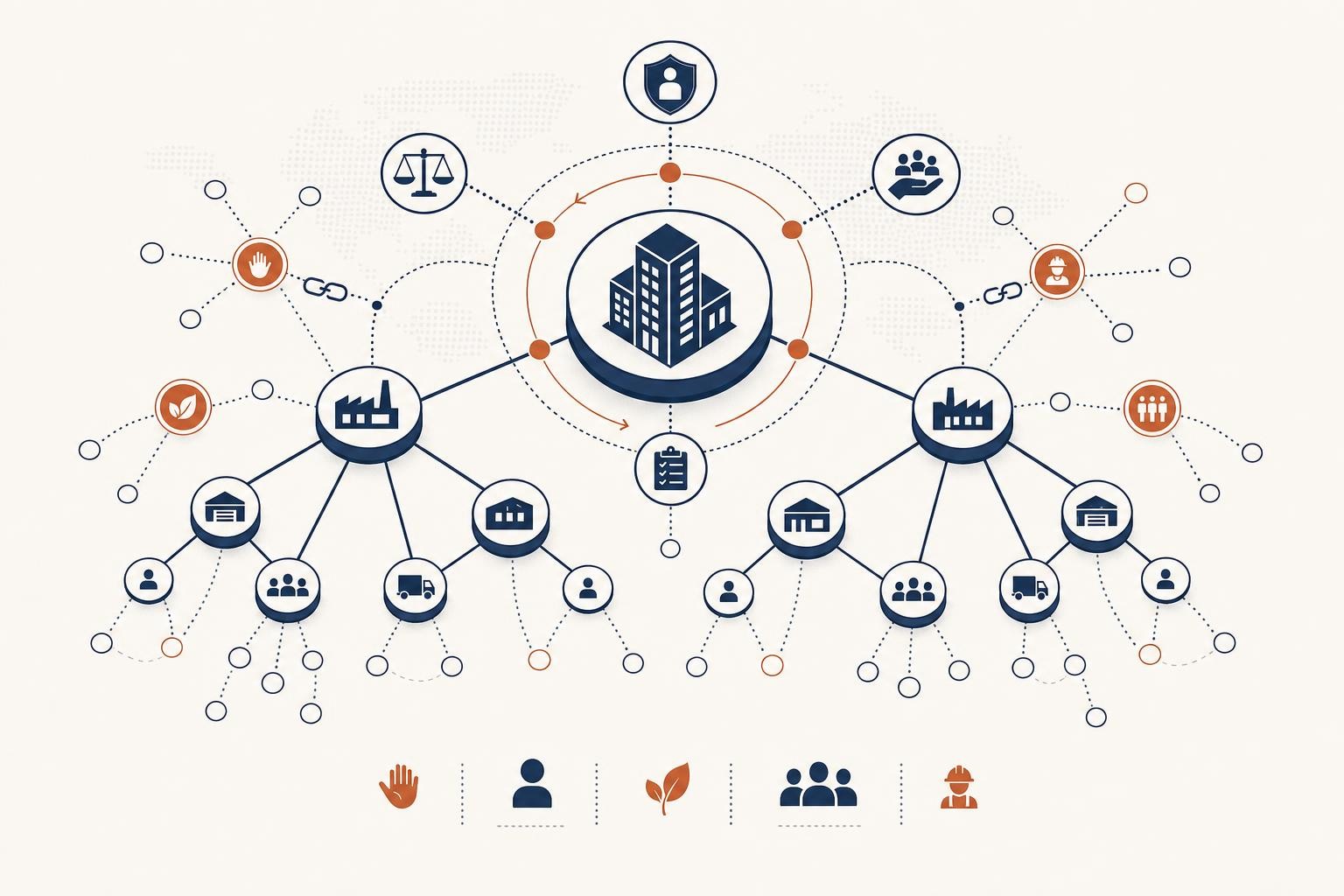
Are you in scope of the CSDDD after Omnibus I?
The short answer: the EU Corporate Sustainability Due Diligence Directive (CSDDD) applies directly only to the largest companies, but it reaches most companies indirectly, through their customers. After the Omnibus I changes, the line between the two is what matters most.
Here's how to work out which side you're on.
Are you directly in scope?
Two simple tests, depending on where your company is based:
- EU companies are in scope if they have more than 5,000 employees and more than €1.5 billion in worldwide net turnover. Both tests must be met.
- Non-EU companies are in scope if they generate more than €1.5 billion of net turnover in the EU - there is no employee test.
- Either way, the duty attaches at the level of the ultimate parent of a group that meets the thresholds.
If that's you, you carry the full due diligence obligation by 26 July 2029. Start with the six-step process.
These thresholds are far higher than the original 2024 directive (1,000 employees / €450m). Omnibus I removed the phased waves and the lower "high-impact sector" threshold, so many companies that were once in scope no longer are - directly.
Not directly in scope? You're probably still affected
This is the part most coverage misses. In-scope companies must run due diligence across their chain of activities - which means they will ask you, as a supplier or business partner, for:
- a completed due diligence questionnaire (covering human rights, labour, environment, ethics);
- a signed supplier code of conduct, with the right for them to verify it;
- sometimes an audit or corrective-action plan.
You don't have a regulator to answer to, but you do have a commercial obligation to your customer. Handling it well protects the relationship. See exactly what large customers ask for.
A quick way to place yourself
- Over 5,000 staff and €1.5bn (or €1.5bn EU turnover)? You're directly in scope - build your programme now.
- Below that, but selling to large EU companies? You're indirectly affected - get a one-page human rights policy and a clean questionnaire answer ready.
- Below that, and not in any large company's supply chain? No direct duty today, but the picture changes if you grow or win bigger customers.
Not sure? Our free Am I in scope? checker walks you through it in a couple of minutes and emails you a tailored next-step list.
Don't over-read the thresholds
Two cautions. First, scope is assessed at group level, so check consolidated numbers, not a single entity. Second, the directive is still being transposed into national law (due by 26 July 2028), and some Member States may go further. We track that on the CSDDD timeline.
Want to be told when the scope rules or national transposition move? Subscribe to The CSDDD Brief.
Sources: Directive (EU) 2024/1760 on EUR-Lex as amended by Directive (EU) 2026/470; European Commission corporate sustainability due diligence pages. Guidance, not legal advice.
Related reading
The UK-EU ETS Linkage Negotiation: What It Means for CBAM Exemption - and When
UK goods entering the EU face CBAM charges today - with no carve-out. The only route to exemption runs through ETS linkage. Here's the state of that negotiation, what it would actually change, and how to plan under uncertainty.
CBAM's Missing Half: What the Temporary Decarbonisation Fund Means for EU Exporters
CBAM equalises carbon costs on imports but leaves EU exporters exposed as free allocation disappears. This post explains the export carbon leakage gap, the proposed Temporary Decarbonisation Fund, and what exporters should do now.
CBAM and Customs Special Procedures: Why Inward Processing Defers Your Obligation, Not Cancels It
Inward processing doesn't exempt you from CBAM - it defers it. Here's exactly when the obligation triggers, what data you need to hold, and who must be the authorised declarant.