CBAM's Diplomatic Front: What India's WTO Challenge and a Carve-Out-Free FTA Mean for Your Sourcing
There is a version of CBAM planning that amounts to waiting. The reasoning goes: the measure is contested, major trading partners are furious, a WTO challenge is coming, the EU wants trade deals more than it wants this particular instrument, and therefore something will give.
Two events in 2026 should have ended that reasoning. The EU and India sealed a free trade agreement in January after nearly two decades of negotiation, and it contains no CBAM exemption. And the dispute itself has hardened into a legal and diplomatic position rather than dissolving into a negotiated carve-out.
This post is about what the diplomatic fight over the EU carbon border tax is actually about, what it can and cannot change, and what a procurement or trade compliance team should do with that information. The short version: trade diplomacy is unlikely to lower your certificate bill, but it will move where your suppliers are and what their carbon data is worth.
The FTA that did not touch CBAM
India and the EU concluded their free trade agreement at the India-EU Summit in New Delhi in January 2026. For Indian exporters, and for EU importers sourcing from India, the obvious question was whether tariff liberalisation would come with relief from the carbon border adjustment. It did not.
The agreement leaves CBAM untouched, and the Commission has been explicit that there is no commitment to alter its CBAM obligations or grant India more favourable treatment (Argus Media).
That is the single most instructive fact in this whole debate. If a trade agreement of that scale, concluded after that long a negotiation, with a partner that considers CBAM a first-order grievance, does not produce a carve-out, it is reasonable to conclude that carve-outs are not on offer. The EU's position is that CBAM mirrors a carbon cost already borne by EU producers under the ETS, and that exempting a trading partner would reintroduce exactly the carbon leakage the instrument exists to prevent. Structurally, that argument does not bend for a bilateral deal.
There is a second-order effect worth noticing, though. Tariff liberalisation plus an unchanged carbon cost changes the relative economics of sourcing from India in a way that is neither purely favourable nor purely adverse. Commentators have pointed out that the carbon cost can materially offset the tariff gains for exactly the goods most affected (Ideas for India). For an importer running a sourcing model, the tariff line and the CBAM line now have to be modelled together, because they move in opposite directions.
What the legal objection actually says
India has objected to CBAM repeatedly at the World Trade Organization, and the objection is more substantive than a general complaint about protectionism. It rests on two arguments that are worth understanding on their merits, because they shape what any eventual settlement could look like.
The non-discrimination argument. CBAM applies the same carbon price to imports regardless of the exporting country's level of development or its own climate commitments. Critics argue that this is discriminatory in effect even where it is neutral on its face, because a uniform carbon price lands very differently on economies at different stages of industrial transition.
The differentiation argument. The Paris Agreement is built on common but differentiated responsibilities. A unilateral border measure that imposes a single carbon standard arguably cuts across that principle by treating a developing economy's steel sector identically to an EU producer's (International Economic Law and Policy Blog).
The exposure behind the argument is concentrated rather than broad. India's CBAM-exposed exports are a small share of its GDP, but iron and steel account for the overwhelming majority of that exposure, which makes this a sectoral fight with national political weight rather than a macroeconomic one (Observer Research Foundation).
India is not alone. Brazil, Indonesia, Türkiye and Vietnam all operate domestic carbon pricing at levels well below the EU ETS, which puts them in the same structural position: priced, but not priced enough to neutralise the border adjustment.
Where the dispute will actually be settled: Article 9
Here is the part that matters operationally. The live question is not whether CBAM survives. It is how much credit a third country's own carbon price earns against the CBAM obligation, and that is decided by the Article 9 implementing act rather than by a WTO panel.
The Commission published a draft implementing regulation on 13 May 2026 setting out how carbon prices effectively paid in third countries can reduce CBAM certificate obligations, opening a four-week consultation (European Commission). The draft covers calculation, evidence and certification requirements across emissions trading systems, carbon taxes, rebates and compensation mechanisms.
Two things follow.
First, this is where the diplomatic pressure is being absorbed. A generous treatment of rebates and compensation would meaningfully reduce the bill for exporters in countries with nominal carbon pricing; a strict one would not. Analysis of how third-country carbon prices should be recognised has become a substantive technical debate precisely because it is the pressure valve (MIT CEEPR).
Second, and importantly for anyone budgeting: the draft was still unadopted through mid-2026. Its evidence, certification and calculation rules are not binding until it is. If your 2026 or 2027 model assumes a specific deduction for a supplier's domestic carbon price, that assumption rests on a draft.
What this means for your sourcing decisions
Translating all of the above into procurement terms:
Do not price in a carve-out. No trade agreement concluded so far has produced one, and the EU's stated position rules one out. A sourcing model that holds a country-level exemption as a scenario is modelling something that is not on the table.
Do price in supplier-level carbon data quality. This is the variable you can actually influence. The difference between a supplier who can provide verified actual embedded emissions and one who cannot is a direct, immediate difference in your certificate bill, and it dwarfs any plausible diplomatic outcome. The escalating markup on default values makes this gap widen over time rather than narrow.
Track the Article 9 adoption, not the WTO docket. A WTO dispute would take years and would not suspend the regulation in the meantime. The implementing act on carbon price deductions changes numbers in your model the quarter it is adopted. One of these is a live input; the other is background.
Ask suppliers what they can evidence, not what they pay. Under the draft rules, a carbon price only reduces your obligation if it can be documented and certified to the standard the implementing act sets. A supplier operating under a domestic ETS who cannot produce evidence in the required form delivers you nothing.
Expect concentration, not diversion. Because exposure is concentrated in steel, aluminium and a handful of other sectors rather than spread across a country's whole export basket, the sourcing response is sector-specific. Broad country-level diversification is usually the wrong lever; supplier-level data readiness within your existing base is usually the right one.
The uncomfortable conclusion
Trading partners have a real grievance, seriously argued, with legitimate questions about differentiation and fairness that deserve to be taken on their merits rather than dismissed as protectionist complaint. Commentators on both sides have suggested the more productive path for affected countries is to shape the rules on carbon price recognition rather than only to contest the instrument (Down To Earth).
But none of that changes what a compliance team should do this quarter. The regime is in force, the carve-outs have not materialised in the one place they most plausibly might have, and the only lever that reliably moves your bill is the quality of the emissions data your suppliers can evidence.
Waiting for the diplomacy to rescue the budget is not a strategy. Getting verified supplier data is.
Related reading
The CBAM Verifier Bottleneck: Why Booking a Slot in Late 2026 Is the Real Compliance Decision
Verifier availability - not data quality - is the binding constraint on using actual embedded emissions for 2026 CBAM imports. Here's the arithmetic, the third-country gap, and what to do in Q4 2026.
The CSDDD Guidelines Are Where Compliance Is Actually Decided - Here's What to Build Before Q1 2027
The Commission's CSDDD implementation guidelines land in Q1 2027 - a year before transposition. They set the evidentiary standard, not the directive. Here's what is unresolved and what to build now.
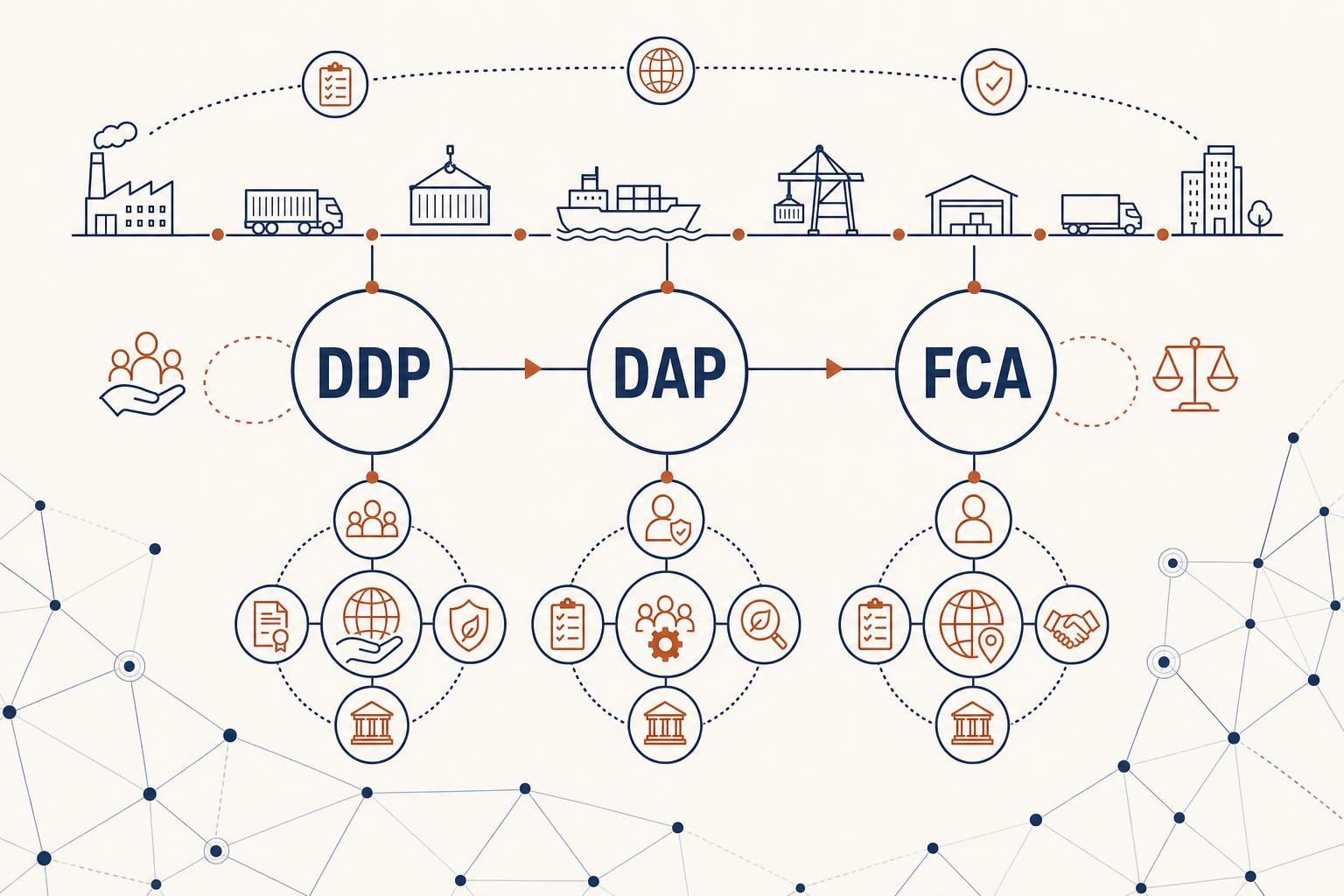
Three Letters, One Liability: How Your Incoterm Decides Who Pays CBAM
DDP, DAP, FCA - three letters in a contract determine who carries CBAM liability. A practical guide for procurement, trade compliance and legal teams on both sides of an EU import deal.