CBAM Penalties and Enforcement: What EU Importers Need to Know
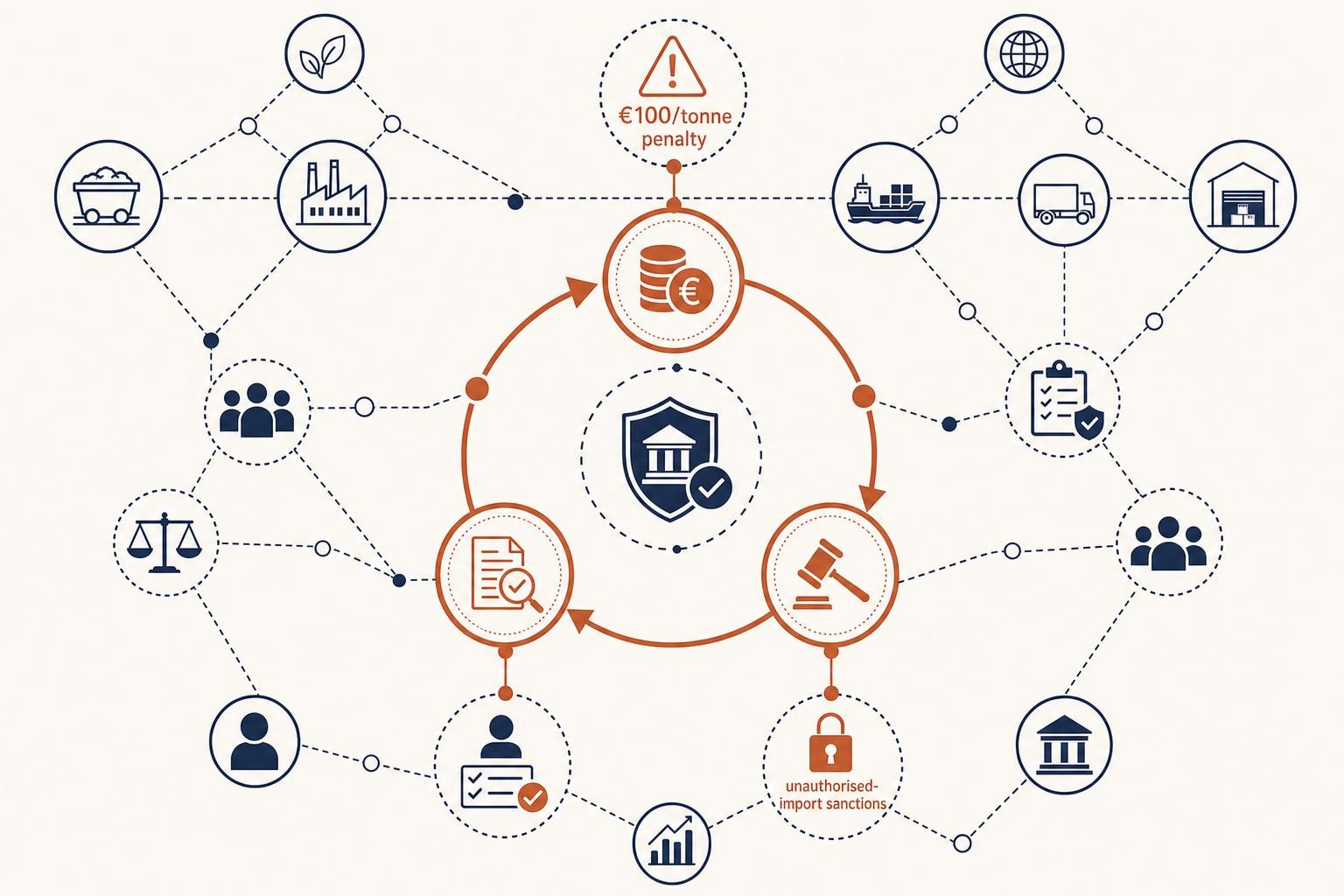
The transitional period - widely treated as a learning phase - ended on 31 December 2025. Since 1 January 2026, the CBAM definitive regime has been live, and with it comes real financial exposure. What began as a transitional reporting exercise now operates as an enforceable regulatory regime with financial consequences. This post focuses squarely on what those consequences look like, what triggers them, and how to avoid them.
The Two Main Penalty Triggers
The CBAM Regulation creates two distinct penalty situations. Understanding the difference matters, because the financial stakes are very different.
1. Failure to surrender enough certificates
Failure to surrender CBAM certificates by authorised declarants will face a penalty of €100 for each certificate not surrendered. Penalties also apply for procedural breaches.
Under Article 16 of the CBAM Regulation, the penalty is €100 per tonne of CO₂e of unsurrendered emissions, adjusted annually for inflation. This figure deliberately mirrors the EU ETS excess-emissions penalty, anchoring CBAM enforcement to the same deterrent logic that governs the carbon market for EU producers.
Two things are critical to understand about this penalty:
- It does not cancel the surrender obligation. Paying the fine means paying both the market price of the CBAM certificates and the €100/tonne fine, making non-compliance extremely costly. The missing certificates must still be surrendered.
- It is separate from certificate costs. These penalties are separate from the cost of purchasing CBAM certificates. A shortfall is therefore a double hit: the certificate cost plus the fine on top.
To put numbers on it: if a steel importer under-reports or fails to report 1,000 tonnes of CO₂ emissions, the fine alone is €100,000, excluding the certificate cost.
2. Importing without authorisation or circumventing the rules
For importers who bring in CBAM goods without being an authorised declarant, or who otherwise circumvent the rules, penalties can range from three to five times the standard €100/tonne rate.
Failing to obtain Authorised Declarant status before importing relevant goods, or importing as a non-authorised person, can lead to fines three to five times higher than the certificate penalty, depending on factors such as intent, duration, and cooperation.
The regulation also strengthens enforcement: authorities can now target artificial import splitting to evade the 50-tonne limit. Non-authorised importers who exceed the threshold face significantly higher penalties than in earlier frameworks.
The 50-tonne de minimis does not apply to electricity or hydrogen. Importers of those goods must be authorised declarants regardless of volume. For all other CBAM goods, exceeding 50 tonnes of net mass per calendar year without authorisation is the trigger for the higher-band penalty.
How Member-State Enforcement Works
The CBAM Regulation sets the penalty framework; individual EU member states implement and enforce it through their National Competent Authorities (NCAs).
The tasks of the competent authorities for the definitive period from 2026 include: examination of applications and authorisation of companies as CBAM declarants; review of CBAM declarations and determination of CBAM certificates to be surrendered; and imposing and enforcing sanctions in the event of infringements by authorised declarants.
The definitive phase marks a deliberate step-change in enforcement intensity. During the CBAM transitional period, enforcement primarily aimed at facilitating learning and improving operators' compliance, with no publicly reported cases of penalties being imposed. In the definitive phase, Member State authorities are expected to intensify oversight and closely monitor compliance.
In practice, misreporting, underreporting, or inconsistencies between customs data and CBAM reports can trigger penalties. Guidance circulated across France, Germany, and the Netherlands signals a common enforcement direction even if national procedures differ.
Stricter monitoring and enforcement by NCAs is also expected during this new phase. The transitional period's tolerance for imperfect data is gone.
Common Ways Importers Slip Into Non-Compliance
Most penalty exposure does not come from deliberate evasion. It comes from process gaps that compound over time.
Here are the four most common failure modes:
Missed or late authorisation. Starting in 2026, companies intending to import more than 50 tonnes of CBAM goods annually into the EU must obtain the status of "Authorised CBAM Declarant." Applications must be submitted no later than 31 March 2026 to avoid penalties and import restrictions. If the application is rejected and CBAM goods exceeding the threshold were imported, penalties will apply to all imports made in 2026.
Over-reliance on default values. Default values are a legitimate fallback, but they carry a mark-up (10-30% depending on sector) and create their own risks. If verification fails or is incomplete, the Competent Authority can issue an assessment using the high default values for the non-verified portion of emissions. Importers who assume default values are a permanent, low-effort solution may find their certificate costs - and any shortfall penalties - are higher than necessary.
Missing third-party verification. The definitive period introduces accredited third-party verification requirements exclusively to importers reporting with actual emissions data. Importers relying on default values are not subject to verification. If you are using actual values - which is the route to lower certificate costs - verification is not optional. Importers who underestimate their embedded emissions - through poor supplier data, calculation errors, or failure to account for all covered imports - will face a gap between their certificate holdings and their verified declaration, triggering enforcement action by the competent national authority.
Quarterly certificate shortfalls. Even though the annual declaration deadline is 30 September 2027 (for 2026 imports), the holding obligation is quarterly from 2027 onwards. From 2027 onwards, an authorised CBAM declarant must ensure that, at the end of each quarter, the number of CBAM certificates held on their account in the CBAM Registry is equal to at least 50% of embedded emissions of all goods they have imported since the beginning of the calendar year. This rule is calculated on a quarterly basis - at the end of each quarter: 31 March, 30 June, 30 September and 31 December. Importers must ensure their CBAM certificate holdings cover at least 50% of required certificates on a quarterly basis. That means quarterly tracking remains crucial for compliance - even though reporting becomes annual.
Penalty Exposure at a Glance
| Scenario | Penalty | Key point |
|---|---|---|
| Certificates not surrendered by deadline (authorised declarant) | €100 per tonne of CO₂e not covered | Adjusted annually for inflation; surrender obligation remains |
| Importing without authorised declarant status / circumvention | 3–5× the standard rate (€300–€500/tonne) | Higher band reflects gravity of unauthorised importation |
| Inaccurate or unverified declaration (actual values) | NCA assessment at high default values + potential fine | Verification gap creates both cost and compliance exposure |
| Quarterly certificate holding shortfall (from 2027) | Enforcement action by NCA; escalating consequences | Must hold ≥50% of year-to-date embedded emissions each quarter |
How to Stay Compliant: A Practical Checklist
The good news: most of these risks are manageable with the right processes in place.
Check that your Authorised CBAM Declarant application has been approved by your National Competent Authority and that you are registered in the CBAM Registry. If you import above the 50-tonne threshold and are not yet authorised, act immediately.
Identify every CN code you import that falls within the six CBAM sectors (cement, iron & steel, aluminium, fertilisers, electricity, hydrogen). Cross-reference against your customs import records to ensure nothing is missed.
If you use actual emissions data from your non-EU suppliers, you must arrange third-party verification by an accredited verifier. If you use default values, verification is not required — but the mark-up means higher certificate costs. Make this decision deliberately, not by default.
Your certificate obligation is only as accurate as your supplier data. Importers who underestimate embedded emissions face a shortfall at surrender. Build a structured data-collection process with your non-EU producers now, ahead of the September 2027 declaration.
From Q1 2027, you must hold certificates covering at least 50% of year-to-date embedded emissions at each quarter-end. Set up internal monitoring so you are not scrambling at year-end. Certificate sales open on the Common Central Platform from 1 February 2027.
Before submitting your annual CBAM declaration, reconcile your embedded emissions figures against your customs import data. Inconsistencies between the two are a known enforcement trigger. The first declaration, covering 2026 imports, is due 30 September 2027.
The Bottom Line
The penalty framework is designed to be dissuasive, not punitive for its own sake. Lighter load for compliant operators, higher stakes for non-compliance. The €100/tonne figure is not a ceiling on your exposure - it is a floor, and it sits on top of the certificate cost you would have owed anyway.
The companies best positioned for this phase are those that invest in data quality, verification, and internal coordination. CBAM enforcement rewards preparation and transparency while penalising assumptions and delays.
If you are unsure where your current processes stand, the self-assessment tool above is a good starting point.
Related reading
The UK-EU ETS Linkage Negotiation: What It Means for CBAM Exemption - and When
UK goods entering the EU face CBAM charges today - with no carve-out. The only route to exemption runs through ETS linkage. Here's the state of that negotiation, what it would actually change, and how to plan under uncertainty.
CBAM's Missing Half: What the Temporary Decarbonisation Fund Means for EU Exporters
CBAM equalises carbon costs on imports but leaves EU exporters exposed as free allocation disappears. This post explains the export carbon leakage gap, the proposed Temporary Decarbonisation Fund, and what exporters should do now.
CBAM and Customs Special Procedures: Why Inward Processing Defers Your Obligation, Not Cancels It
Inward processing doesn't exempt you from CBAM - it defers it. Here's exactly when the obligation triggers, what data you need to hold, and who must be the authorised declarant.