CBAM Certificates in 2027: How the Price Is Set, How to Buy, and How to Meet the 50% Holding Rule
CBAM has been a reporting exercise for three years. From 1 February 2027 it becomes a purchasing exercise. Authorised declarants will buy CBAM certificates, hold them against a quarterly test, and surrender them for the first time on 30 September 2027. This guide covers the mechanics a finance or trade-compliance team needs to plan around: how the carbon border adjustment certificate price is set, who can buy, what the quarterly surrender rules require, and where the money can go wrong.
For the full date-by-date timeline, see our CBAM compliance calendar. This post focuses on the mechanics behind those dates.
How the certificate price is set
The price is not negotiated and not quoted by a broker. It is derived from EU ETS auction prices, and the averaging period changes between 2026 and 2027.
For 2026, the price is the quarterly average of EU ETS auction clearing prices. The published figures so far are EUR 75.36 per tonne of CO2e for Q1 2026, EUR 75.28 for Q2 and EUR 82.32 for Q3 (CBAM certificate guide).
From 1 February 2027, the price moves to the weekly average of EU ETS auction closing prices, published each Monday by the Commission under Implementing Regulation (EU) 2025/2548 (CBAM certificate guide). The practical consequence is that the price you pay depends on the week you buy. A declarant who buys in one lump on a single date takes on timing risk that a staged purchase programme avoids.
Who can buy, and where
Only authorised CBAM declarants can buy certificates. The authorisation deadline for continuing importers was 31 March 2026, so anyone not authorised by now cannot take part in the central sale. If your application is still pending, read our guide to what the provisional regime protects and what happens if you are refused.
Purchases run through the Common Central Platform, operated by the Commission and accessed through the CBAM Registry. A transaction fee of EUR 0.05 per certificate has appeared in draft form but was not adopted at the time of the source we reviewed, so treat it as unconfirmed (CBAM certificate guide).
One certificate corresponds to one tonne of verified embedded CO2e. Certificates are non-tradable between declarants, so you cannot sell a surplus to a peer.
The quarterly 50% holding rule
This is the rule that catches finance teams out. At the end of each quarter (31 March, 30 June, 30 September and 31 December), an authorised declarant must hold certificates equal to at least 50% of the cumulative embedded emissions of goods imported in the year to date. A shortfall attracts a penalty of EUR 100 per tonne of CO2e on the gap (CBAM certificate guide).
The 50% test applies to the certificates you actually have to surrender, which is not the same as your raw embedded emissions. The free allocation adjustment reduces the number of certificates due. In 2026 the CBAM factor is 2.5%, so declarants surrender certificates on only that share of verified embedded emissions, and the factor rises each year until free allocation ends on 1 January 2034. The Commission explained the calculation in Guidance No 4, one of ten CBAM guidance documents published on 14 August 2026 (guidance summary).
We recommend confirming exactly how the holding test interacts with the adjusted quantity against the implementing act text and your national competent authority before you finalise a purchasing policy. Summaries differ in how they describe the base for the 50% calculation.
Surrender, repurchase and cancellation
The first annual declaration and surrender fall on 30 September 2027 and cover 2026 imports. After that, the deadline is 30 September each year.
If you hold more certificates than you end up needing, there is a repurchase right. You can ask for surplus certificates to be bought back at the original purchase price until 31 October of the surrender year, but only up to the number you were required to hold under the quarterly 50% rule for that year, and a draft limit of one request per declarant per year applies (CBAM certificate guide).
Unused certificates do not last indefinitely. Under Article 24(1), certificates from two calendar years earlier are cancelled on 1 November each year. A first-cycle exception under Article 24(2) cancels certificates bought in 2027 for 2026 emissions on 1 November 2027 if they were neither surrendered by 30 September nor repurchased by 31 October.
What it costs: a labelled worked example
The figures below are an illustration, not a forecast. Assume a declarant imports goods with 10,000 tonnes of verified embedded CO2e in 2026, uses the Q3 2026 price of EUR 82.32 as a stand-in for the 2027 purchase price, and applies the 2026 CBAM factor of 2.5%.
Certificates to surrender: 10,000 x 2.5% = 250. Indicative cost: 250 x EUR 82.32 = EUR 20,580.
The point of the example is the scale, not the number. In 2026 the bill is small because the factor is small. The risk is that teams build the purchasing process, approvals and treasury workflow for a EUR 20,000 problem, then meet a far larger one as the factor rises toward full phase-in. Our cost trajectory guide shows how steep that curve gets. Default values also carry a mark-up that rises over time, which is another reason to move to verified actual data.
A practical buying plan
- Confirm your authorised declarant status and registry access well before 1 February 2027.
- Estimate certificates due from your 2026 verified or default-based emissions, using the adjusted quantity, not raw tonnes.
- Set a quarterly holding target for each of the four checkpoints and put the dates in your treasury calendar.
- Buy in tranches across several weeks rather than on one date, to spread weekly price exposure.
- Decide in advance how you will use the repurchase window before 31 October.
- Keep the purchase records with your declaration file. Documentation must be retained until the end of the fourth year after the declaration year, as our record-keeping guide explains.
FAQ
When can I first buy CBAM certificates? From 1 February 2027, through the CBAM Registry's central platform, if you are an authorised declarant.
How is the 2027 price calculated? As the weekly average of EU ETS auction closing prices, published each Monday.
What happens if I miss the quarterly 50% holding level? A penalty of EUR 100 per tonne of CO2e applies to the shortfall.
Can I resell certificates I do not need? No. They are non-tradable, but a limited repurchase at the original price is available until 31 October.
Do I need to buy certificates for 2026 imports? Yes, but the quantity due is reduced by the free allocation adjustment, which makes the 2026 obligation small. Surrender is due on 30 September 2027.
Related reading
The CBAM Verifier Bottleneck: Why Booking a Slot in Late 2026 Is the Real Compliance Decision
Verifier availability - not data quality - is the binding constraint on using actual embedded emissions for 2026 CBAM imports. Here's the arithmetic, the third-country gap, and what to do in Q4 2026.
The CSDDD Guidelines Are Where Compliance Is Actually Decided - Here's What to Build Before Q1 2027
The Commission's CSDDD implementation guidelines land in Q1 2027 - a year before transposition. They set the evidentiary standard, not the directive. Here's what is unresolved and what to build now.
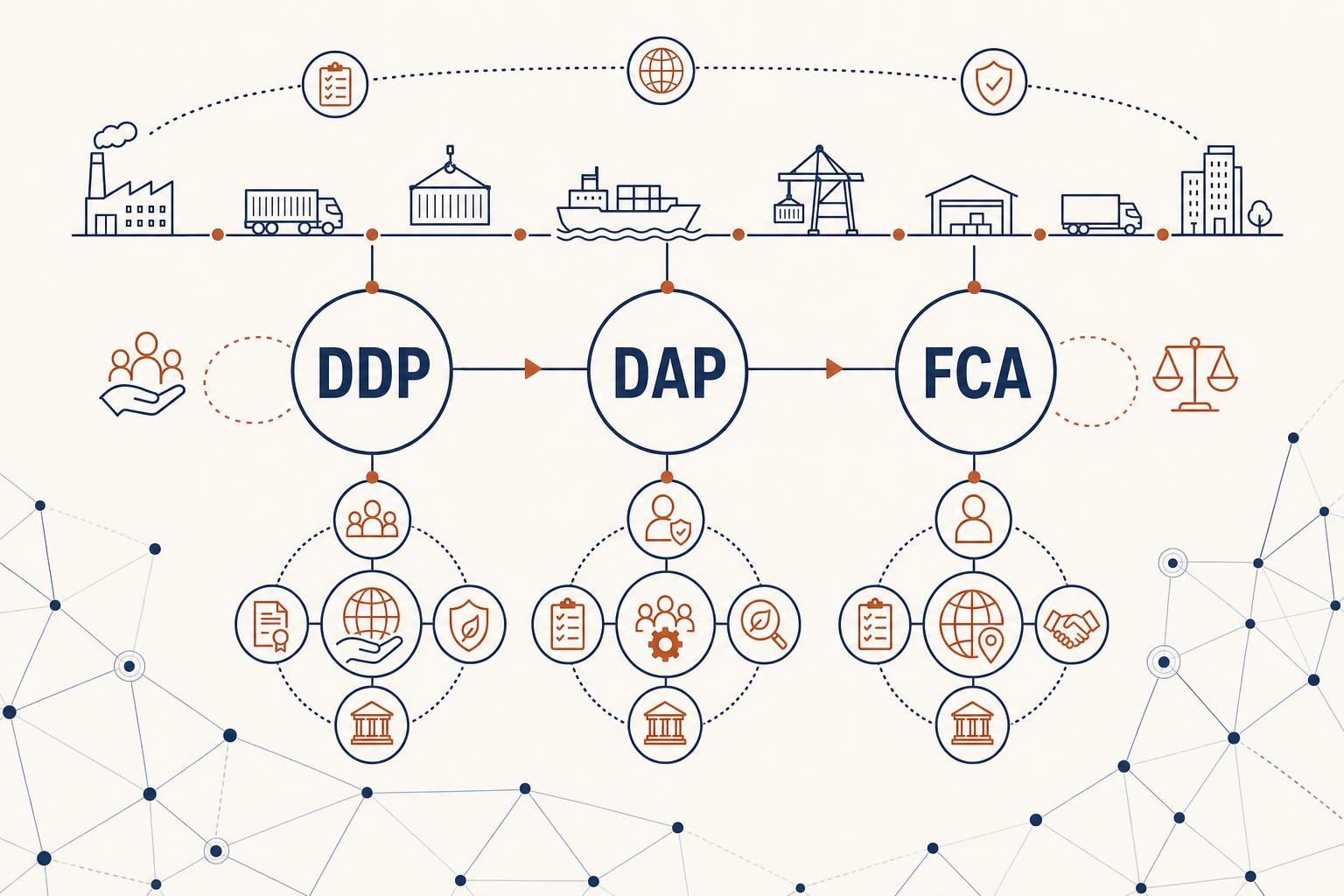
Three Letters, One Liability: How Your Incoterm Decides Who Pays CBAM
DDP, DAP, FCA - three letters in a contract determine who carries CBAM liability. A practical guide for procurement, trade compliance and legal teams on both sides of an EU import deal.