The CBAM Accredited Verifier: A Practical Guide for EU Importers and Their Suppliers
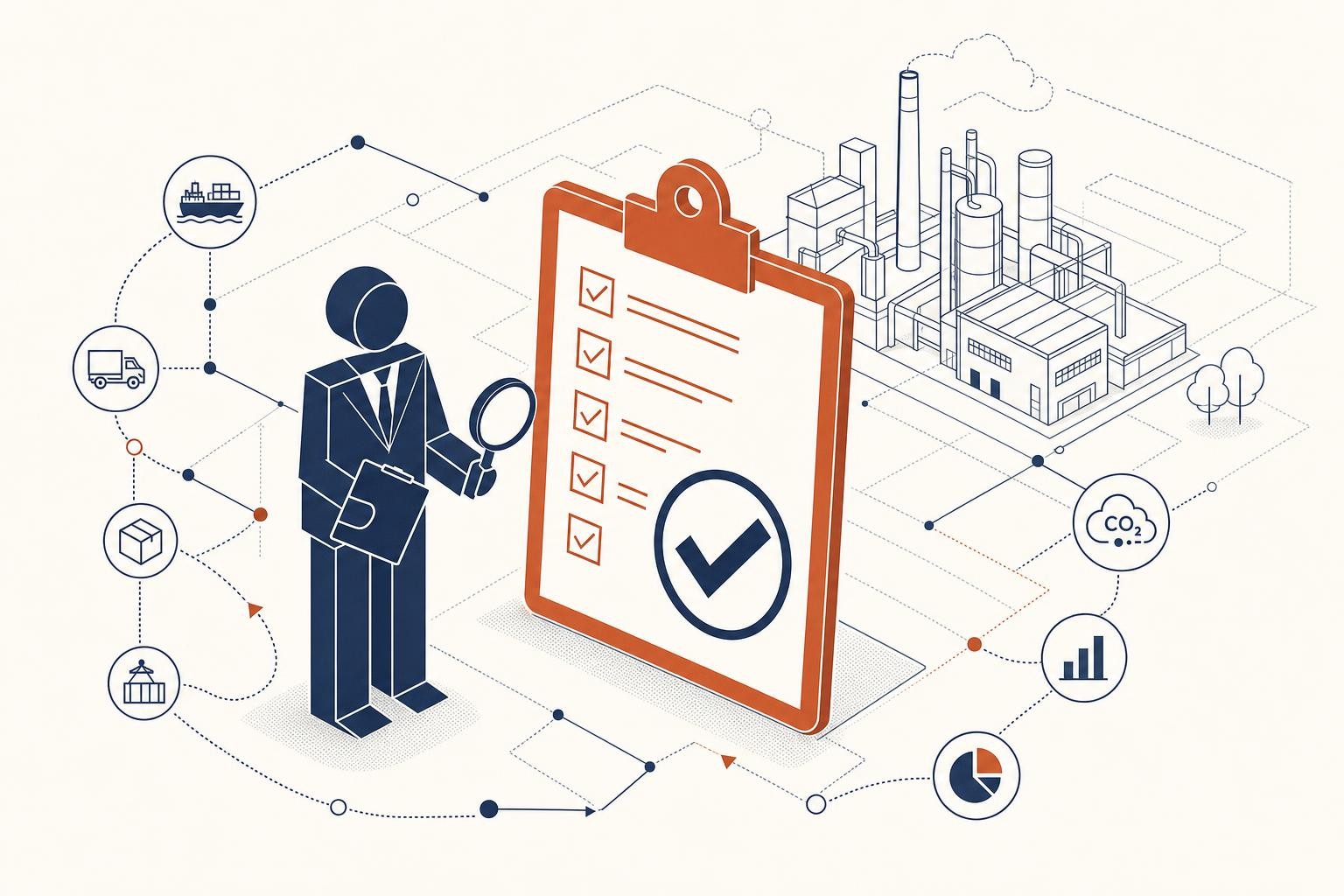
If you want to declare your supplier's actual embedded emissions in your CBAM annual declaration - rather than fall back on the EU's punitive default values - you need one thing that didn't exist before 2026: an accredited third-party verifier.
This guide focuses specifically on that verification step: who qualifies to do it, how they get accredited, what they actually check at your supplier's facility, what it costs, and why the 2026-2027 timeline is tighter than it looks.
Why verification exists - and why it only applies to actual data
From 1 January 2026, accredited verification of embedded emissions became a legal requirement for any company wishing to declare actual emissions data in a CBAM annual declaration. Importers who rely on EU default values instead are not subject to verification at all.
The logic is straightforward. Default values are set conservatively - with a mark-up of 10% above the calculated default in 2026, rising to 30% from 2028 - so the EU doesn't need to verify them. But if you want to use your supplier's lower, installation-specific figures, the EU needs confidence that those figures are real. That's what an accredited verifier provides.
The legal basis sits across several instruments: the primary CBAM Regulation (EU) 2023/956, Implementing Regulation (EU) 2025/2546 (which sets verification principles and site-visit rules), and Delegated Regulation (EU) 2025/2551 (which governs verifier accreditation). You can find the Commission's own summary on the official CBAM verification page.
What is an accredited CBAM verifier?
A CBAM verifier is not a consultant, an auditor, or a software platform. It is a specific legal entity that has been formally accredited to verify embedded emissions under CBAM rules.
The embedded emissions must be verified by an independent body accredited according to Regulation (EC) No 765/2008 by an EU or EEA National Accreditation Body (NAB). Those NABs are members of the European Accreditation (EA) network - the body that coordinates accreditation standards across Europe.
The accreditation standard itself is EN ISO/IEC 14065 - the same standard used for EU Emissions Trading System (EU ETS) verification. This is deliberate: CBAM verification is modelled closely on ETS practice, so bodies already accredited for ETS work are the most likely early candidates for CBAM scope extensions.
A few important constraints:
- Individual consultants cannot act as accredited verifiers. Only legal entities qualify.
- The verifier must be independent from the installation it verifies - no conflict of interest.
- Accreditation must specifically reference the CBAM activity groups the verifier intends to cover (iron and steel, cement, aluminium, fertilisers, electricity, hydrogen). A body accredited for steel cannot automatically verify cement.
- Non-EU verifiers can qualify, provided their accreditation body has a recognised mutual recognition agreement with European Accreditation. UK-based UKAS-accredited bodies, for example, may qualify under this route.
EN ISO/IEC 14065 accreditation through a non-EA-member NAB does not satisfy the CBAM verifier requirement. Before engaging any body, confirm that their accreditation body is an EA member — or holds a recognised mutual recognition agreement with EA.
How a verifier gets accredited
The accreditation process runs through the NAB of the EU member state where the verification body is established. For bodies in third countries, they must approach an EU NAB that provides CBAM accreditation.
The key NABs include DAkkS (Germany), COFRAC (France), RvA (Netherlands), and ACCREDIA (Italy). EA publishes a searchable directory of member NABs at european-accreditation.org.
The accreditation assessment checks that the verification body can demonstrate:
- A management system meeting EN ISO/IEC 14065 and EN ISO/IEC 17029 requirements
- Impartiality and confidentiality procedures
- Sector-specific technical competence - including knowledge of the manufacturing processes and the CBAM embedded-emissions calculation methodology
- A structured verification team: a lead verifier, technical experts for the relevant sector, and a mandatory independent reviewer who was not involved in the verification work itself
The first CBAM verifiers are expected to receive accreditation around September 2026. After receiving accreditation, a verifier must apply for access to the CBAM Registry through the competent authority of the member state where its NAB is located. That application cannot be made before 30 September 2026, and must be submitted within two months of receiving accreditation. Only once registry access is granted can the verifier submit verification reports.
What the verifier actually checks
Verification applies at the level of the individual production installation - not the company, not the country. Each facility your supplier operates that produces CBAM goods needs its own verification report.
The process follows a risk-based approach aligned with EU ETS practice:
- Strategic analysis - the verifier reviews the installation's monitoring plan, production processes, and data flows to identify where misstatement risk is highest.
- Document review - emissions calculations, activity data (fuel consumption, production volumes, energy inputs), emission factors, and supporting records are examined against the CBAM methodology in IR 2025/2547.
- Physical site visit - see below.
- Data sampling - the verifier tests a sample of underlying data against source records to check traceability.
- Risk assessment - the verifier applies a 5% materiality threshold: misstatements or non-conformities that exceed 5% of total specific embedded emissions are considered material and must be resolved before a satisfactory opinion can be issued.
- Verification report - the verifier issues a report with a clear opinion (satisfactory or unsatisfactory), submitted via standardised electronic templates in the CBAM Registry.
If the opinion is unsatisfactory, the importer cannot use actual data for that installation and must fall back on default values for those goods.
The mandatory site visit - and why it matters
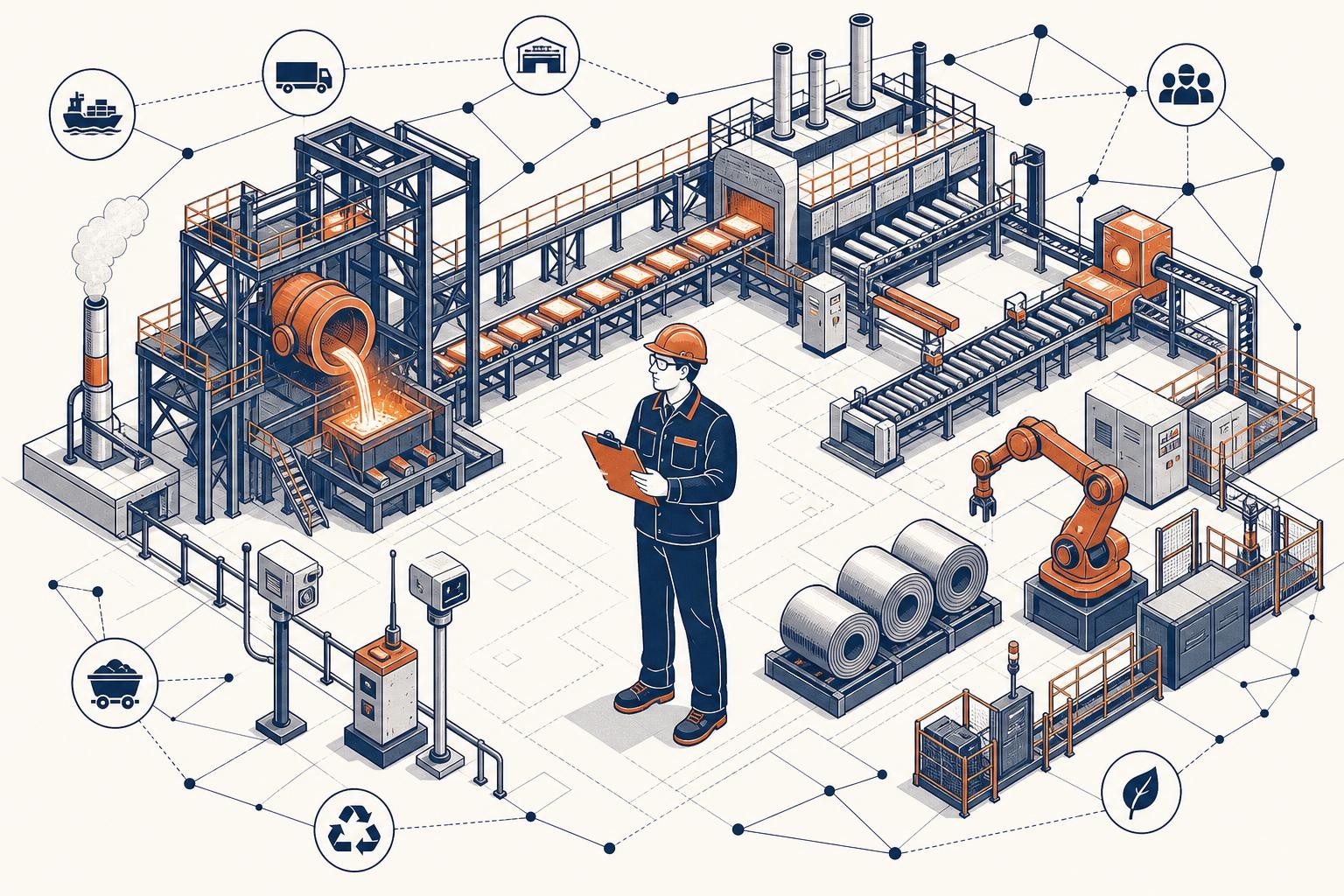
For the first verification period (calendar-year 2026 imports), the verifier must conduct a physical site visit that includes a facility walk-through, process observation, document review, and data sampling. The visit is not optional and cannot be substituted by a video or remote inspection.
This is the single most operationally demanding aspect of CBAM verification. Your supplier's facility - whether it's a steel mill in India, an aluminium smelter in Turkey, or a fertiliser plant in Egypt - must be physically visited by the verification team before a compliant report can be issued.
From 2027 onwards, the rules become more flexible: virtual visits or waivers become possible for low-risk installations where no significant changes have occurred, but a physical visit must still take place at least once every two years.
For 2026, there are no shortcuts.
What it costs
Verification costs roughly EUR 5,000-50,000 per production installation. The wide range reflects real variation:
| Factor | Effect on cost |
|---|---|
| Installation complexity (simple vs. multi-process) | Higher complexity -> higher cost |
| Sector (electricity is simpler; steel/cement more complex) | Simpler sector -> lower cost |
| Location of facility (travel costs for site visit) | Remote locations -> higher cost |
| Number of installations in one engagement | Volume discount of 15-25% typical |
| Verifier's existing sector expertise | Specialist bodies may price differently |
A single verifier can cover multiple installations in one engagement, and multi-installation contracts typically attract volume discounts. The verifier issues a separate report for each installation, since each report corresponds to a specific facility referenced in the annual declaration.
The 2026-2027 timeline - and why it's tighter than it looks
Here is the problem in plain numbers:
Verifier registration in the CBAM Registry opens 1 September 2026, giving accredited firms roughly 13 months to conduct site visits across thousands of non-EU facilities in China, India, Turkey, the UAE, and Egypt before the 30 September 2027 declaration deadline.
That sounds like enough time. It isn't, for two reasons.
First, the accreditation process itself takes months. The first accreditations are expected around September 2026, and registry applications cannot be submitted before 30 September 2026. Verifiers will only be operational in the CBAM Registry in late 2026 at the earliest.
Second, site visits to non-EU facilities require international travel, scheduling with facility operators, and a full document review before the visit even takes place. For first-period verifications requiring physical site visits to facilities in Asia, Africa, or the Middle East, a 6-9 month engagement window from contract signature to report delivery is prudent. That means targeting engagement by Q3-Q4 2026 to secure verifier availability before demand peaks.
How to find an accredited CBAM verifier
As of mid-2026, the official list of accredited CBAM verifiers has not yet been published - the Commission has confirmed it will be published on the CBAM verification page once accreditations are granted.
In the meantime, the most reliable channels are:
- Your country's NAB - each EU member state's NAB maintains a public register of accredited verification and validation bodies under ISO 14065. Contact DAkkS, COFRAC, RvA, ACCREDIA, or your own national body directly.
- The EA directory - European Accreditation publishes a searchable directory of member NABs and their accredited bodies at european-accreditation.org.
- EU ETS verifiers - bodies currently accredited for EU ETS installation verification under EN ISO 14065 are the most likely early CBAM candidates, since the accreditation standard overlaps substantially. Names active in this space include SGS, Bureau Veritas, TÜV, DNV, and RINA - though CBAM-specific accreditation status should be confirmed directly with each body.
Before committing to any verifier, ask:
- Is your accreditation body an EA member (or does it hold a recognised MRA with EA)?
- Have you completed CBAM Registry registration (or applied)?
- Do you have accreditation specifically covering the relevant CBAM activity group (e.g. iron and steel, aluminium)?
- Have you conducted CBAM verification - or EU ETS verification - for this sector before?
- Can you conduct a physical site visit to our supplier's facility in [country] within the required timeframe?
Next steps: what to do now
The verification market is new, capacity is limited, and the clock is running. Here's what to do:
Identify every non-EU production facility supplying you with CBAM goods in 2026. Each installation needs its own verification report. Confirm CN codes and check whether you're above the 50-tonne de minimis threshold.
Your supplier needs to have a monitoring plan in place and be collecting installation-level data throughout 2026. The verifier cannot verify data that was never monitored. Engage suppliers before they start production cycles, not after.
Contact your country's NAB and check the EA directory for bodies with EN ISO/IEC 14065 accreditation in the relevant sector. Shortlist two or three candidates and ask the five questions above.
Don't wait for the official verifier list to be published. Approach candidate bodies now, agree scope and terms, and target contract signature by Q3 2026 at the latest. Verifier capacity will be constrained once the registry opens.
The verifier will need process flow diagrams, monitoring methodology documentation, GHG accounting records, and activity data. Starting this preparation early reduces the risk of a delayed or unsatisfactory verification opinion.
The verification report must be complete before you file. Build in buffer time — if the report is delayed, you cannot use actual data and must fall back on default values for that installation.
The verification step is genuinely new territory for most importers and their suppliers. The accreditation framework is solid, the legal requirements are clear, and the bodies that will do this work are preparing - but the window between registry opening (September 2026) and declaration deadline (September 2027) is short. Starting supplier and verifier conversations now is the single most useful thing you can do.
Related reading
The UK-EU ETS Linkage Negotiation: What It Means for CBAM Exemption - and When
UK goods entering the EU face CBAM charges today - with no carve-out. The only route to exemption runs through ETS linkage. Here's the state of that negotiation, what it would actually change, and how to plan under uncertainty.
CBAM's Missing Half: What the Temporary Decarbonisation Fund Means for EU Exporters
CBAM equalises carbon costs on imports but leaves EU exporters exposed as free allocation disappears. This post explains the export carbon leakage gap, the proposed Temporary Decarbonisation Fund, and what exporters should do now.

CBAM and Customs Special Procedures: Why Inward Processing Defers Your Obligation, Not Cancels It
Inward processing doesn't exempt you from CBAM - it defers it. Here's exactly when the obligation triggers, what data you need to hold, and who must be the authorised declarant.